Following on with our penchant for all things Canadian, this post is the initial collection of verses displayed here on August 10, 2020 (native land #1).
CURRENT CONTENTS (#1)
Canadian spelling
Speech borrowings
Canadian raising
Canadian weather
Toronto / Buffalonian

Authors' Note:
centre: word-form used for 'population hubs' in the majority of English-speaking countries, exactly equivalent to the American center
traveller: ditto (American = traveler)
The American visitors were not quite correct. We Canucks, if we were so motivated, would "practise pre-empting dissenters". But, as Canadians are inherently mannerly, few among us would ever consider such a response, eh?


Authors' Note: The metaphorical use of 'borrowing' in the context of speech and ideas continues, often without payback/return, in the examples of 'borrow a word/phrase', 'borrow a page', 'borrow an idea', etc.
Characteristic differences in speech between Canada and adjacent regions of the United States involve words such as eh, out, borrow and sorry. Exposure to a flood of American-based media has eroded some of these differences; but as our national anthem says, "We stand on guard for thee."
Readers may note that, as an intentional measure of international friendliness, the above verse maintains its rhymes when read with either a Canadian or American accent.
Authors' Note: This is a mostly true story.
The Canadian internist in question had moved south to undertake a fellowship at an American medical school. As an introduction to potential staff mentors, he was asked to prepare a lecture on aspects of gout.
The transcriptionist, a southern woman, was victimized by her unfamiliarity with "Canadian raising", a speech variation altering and shortening the sounds of vowels in words like house, rice and out; this pattern affects the speech of many speakers in the northern US, as well as in Canada.
Authors' Note: This verse was inspired by a character in a verse by OEDILF chief editor, Chris J. Strolin, who railed against the use of the incorrect term 'Canadian goose'.
In fact, when our protagonist Bruce was insightfully contemplating the introduction of moose into suitable environment in Newfoundland (NEW-found-land), the island was a separate British colony. As railway building had recently opened the island's interior, it was hoped that hunters would be attracted in search of a species in decline in the US and parts of Canada.
In 1904, four eastern moose from New Brunswick (that subspecies is known as Alces alces americana) had been set loose on the island. Ultimately Newfoundland, including its burgeoning population of moose, joined the Canadian confederation in 1949.
The rest is history, eh? Newfoundland now (2023) has the densest population of moose in North America, accounting for 150,000 of the continent's million remaining large ungulates.
Authors' Note: hinterland: a geographic term for 'interior', derived from the German adverb hinder = 'behind'.
The author contends that the summary he received overemphasized the adverse climatic conditions faced by Canadians, the majority of whom live in the more temperate southern portions of the country.
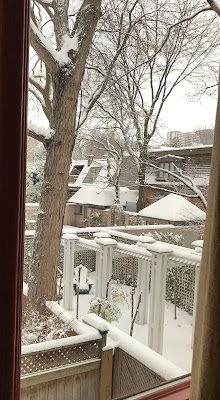 |
mid-November in Toronto
|

Authors' Note:
Buffalonian: a native of Buffalo, New York, in the northern tier of American cities, located 90 miles (150 km) from Toronto, Canada
northern cities vowel shift: linguistic term for the key element in a regional accent whose use peaked in a band across the northeastern portion of the United States. Its use there is apparently now declining, but it has never been used in adjacent parts of Canada; the dialect is known as the Great Lakes dialect, Inland North dialect, or Inland Northern American English.
Buffalo Bisons: a class AAA minor league baseball team (Toronto Blue Jays affiliate).


No comments:
Post a Comment