CURRENT CONTENTS:
American goldfinches
Birdfeeder (squirrel-proof)
Bird dropping
Boat-tailed grackle
California scrub-jays
Cattle egrets
Cedar waxwings
Dawn chorus
(for continuation, see the link below)
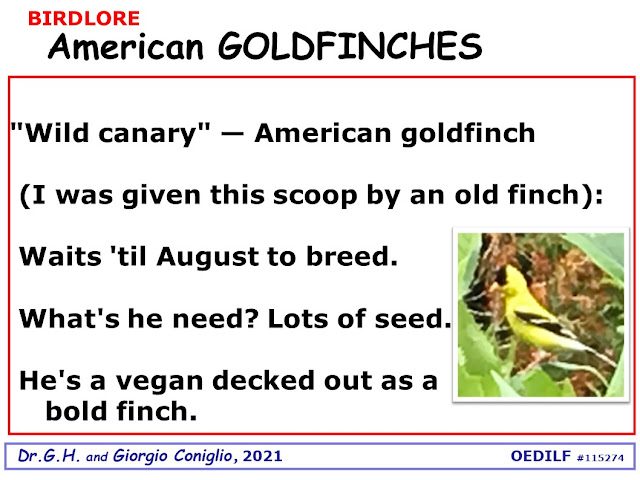
Authors' Note: This common North American bird species, Spinus tristis, is often referred to as the "wild canary" owing to the male's bright yellow summer coat, set off by black wings with white ribbons and black forehead patch. As their diet consists almost entirely of seeds, nesting does not begin until mid-or late summer when weed seeds become plentiful. Thistle heads are used not only to feed the young, but also to construct the nest! The relative dietary habits of finches around the globe (insects versus seeds) has been an area of intense biologic study (see the verse "Darwin's finches” at OEDILF.com).


Authors' Note: Although its use appears cute, the term bird-turd displays your ignorance. The appropriate expression is pronounced as BEHRD drahp-ing in usual discussions.

Authors' Note: The glossy black male and the much-smaller tawny female are often seen hanging around seaside locales near urban marshes in southern US towns. The characteristic call — a high-pitched jeeb or jeeb-jeeb, not a crow-like caw, gives them a simplified name. Undisturbed by close human contact, and with a penchant for grabbing and enjoying human snack-foods, they are likely to become a more pervasive and irritating pest.
 |
| male in flight |
 |
| female, smaller, and with tawny coloring holds onto a treat that she discovered near the boardwalk |


Bird-watchers, academic ornithologists, wordplay enthusiasts, wildlife photographers, Giorgio's relatives, and just everyday folks have united in their demand for more verses on the topic of landbirds!
So, please follow this link! for 'birdlore, part #2'
GENERAL DIRECTIONS FOR WEB-EXPLORERS:
To resume your review of the sequence of daily titillations on our related blog "Daily Illustrated Nonsense", click HERE. Once you arrive, you can select your time frame of interest from the calendar-based listings at the bottom of the page, and check the daily offerings for any month from the start of 2020 until July 2025.
As of July 20, 2025, there are 2,000 unique entries available on the daily blog, displaying individual poems (often illustrated) and wordplay, but also with some photo-collages and parody song-lyrics.
Most of these key elements of our work are assembled here on "Edifying Nonsense" in topic-based collections.
The "Daily" format, a formidable mix of genres has the advantage of including song-lyrics, videos and other material that are not shown here on this topic-based blog.


No comments:
Post a Comment