CURRENT CONTENTS:
Atrial fibrillation
Atrial flutter
Author’s Note: Atrial fib, also abbreviated to a-fib is medical jargon for atrial fibrillation, a common arrhythmia (abnormal pattern of beating) derived from disease of the atria, the upper cardiac chambers. Definable causes for a-fib include various heart and lung conditions, particularly valvular heart disease, but half of cases occur spontaneously, particularly in the elderly. Although relatively benign compared to ventricular arrhythmias, a-fib may be associated with the formation of potentially mobile blood-clots in the atria of the heart, leading to increased risk of brain stroke.
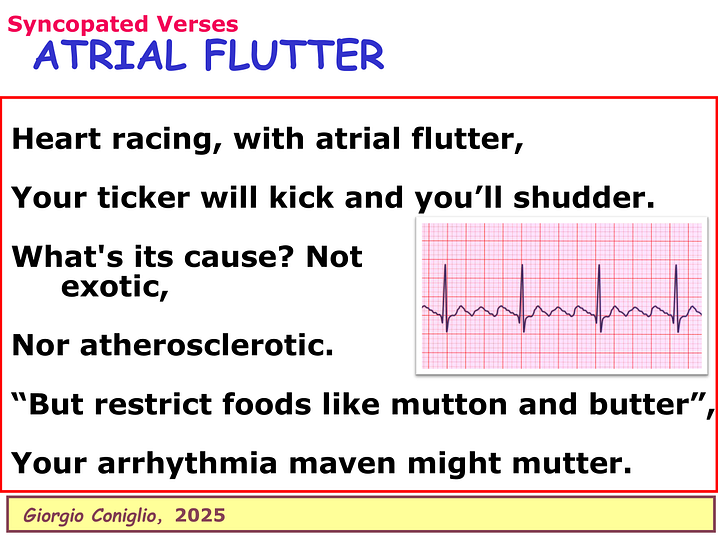
Author’s Note: Diagnosis and treatment of arrhythmias, as discussed here, is the field of endeavour of a subgroup of cardiologists (sometimes thought of, by the author as “the rhythm band”). Atrial flutter, a not-uncommon problem, is diagnosed by a regular pattern on the electrocardiogram. One sees P-waves (atrial complexes) at a rate of 300 per minute on the cardiogram, with relative block at the atrio-ventricular node resulting in a rapid but regular ventricular rate, and peripheral pulse rate often about 150 beats per minute. Symptoms include chest sensation of palpitations and general weakness. Atrial flutter is not routinely associated with coronary artery disease.

Author’s Note: The bundle of His (pronounced HISS), as it is best known, is an important part of the heart’s electrical conduction system, described by anatomist Dr. Wilhem His Jr. (1864–1934). Abnormal function of this tissue is a major cause of heart block.

Author’s Note: Although cardiac arrhythmias, either too fast (tachycardia) or too slow (bradycardia), may be life-threatening, they are hard to pin down as they oftentimes are initially transient. Episodes are not necessarily intensely symptomatic, and most often occur outside the doctor’s office. The Holter monitor, a type of portable electrocardiogram, allows the continuous collection of a patient’s cardiac rhythm for a period of at least a day with the patient’s concurrent recording of possible related symptoms, and subsequent timely software-enhanced diagnostic interpretation of the recorded tracings.
The Holter monitor, embodying concepts conceived during investigation of radio telemetry by experimental physicists including Norman J. Holter, was released for medical application in 1962.

Author’s Note: Torsade de pointes (tor-sad duh PWAnT) or twisting of the peaks, named in 1966 by its French discoverer, is an abnormal pattern seen on the ECG, characterized by ‘twisting’ or cycling of the height of the ventricular ‘QRS’ complexes, and is often associated with inherited or acquired factors that inappropriately widen the ‘Q-T’ interval on the tracing. This unusual pattern of individual beat complexes is associated with nasty ventricular arrhythmias (beat irregularity) and sudden death. If you are lucky, you have survived the initial episode and have correctable factors (e.g. electrolyte disorders, certain pharmaceuticals, etc.).
Flying straight is a casual metaphor associated with performing expected or routine function.

Author’s Note: This is a true account of a medical encounter in which the author recently participated. Atrial fibrillation, although often a persistent condition, may be an intermittent phenomenon experienced by a patient. Usually such persons, when their pulse is regular and normal in frequency will have no symptoms and no abnormalities of the cardiac complexes on their ECG. Also, for part of the time they are subject to irregularities in heart-rate and rhythm, there will not be definite symptoms. Holter monitoring, now technically possible for periods of several weeks, may be useful in uncovering these subtle episodes, particularly those occurring during sleep or distracting activities. Nonetheless, even intermittent atrial fibrillation subjects the patient to an increased risk of cerebral stroke and to the physical dangers induced by the weakness and dizziness that may accompany significant tachycardia.
In the author’s case, his history, extending over a decade, of brief and infrequent episodes of transiently irregular pulse-rate, had finally been clarified by ECG recordings. The embedded photo in the final verse confirmed the finding of intermittent atrial fibrillation. In the most recent episode, the pattern persisted for most a day, with ventricular rate persisting at over 130 beats per minute, verified by hours of monitoring in the Emergency Room. But the pattern reverted to “sinus rhythm” spontaneously, just as he was about to be pharmacologically treated for ventricular rate-control.

Author’s Note: The sino-atrial node is a small focus of specialized cardiac tissue situated in the right atrium near the entry of the vena cava. It has auto-excitatory properties, initiating electrical impulses that travel through the atria. In humans at rest, the baseline rate averages 50 to 80 per minute, but is influenced by its nerve supply from the autonomic nervous system, e.g. during exercise. In the absence of disease, the rate is presumed to be controlled by this intrinsic “pacemaker of the heart”, hence the jargony term “sinus rhythm”. The sino-atrial node, you might note, has nothing to do with China.
To clarify another area of linguistic confusion, here’s the lowdown on names for some cardiology tests that you might hear — used by your arhythmia consultant or their residents (trainees).
ECG (electrocardiogram): the commonly used term internationally to describe the standardized tracing of electrical activity based on 12 surface (i.e. skin) leads. And the exercise ECG is usually termed a “stress test”.
EKG (elektrokardiogramm, in German): exactly the same test as above, but the original German name seems to have gotten stuck there, and is still used predominantly in the USA (Go figure!)
“echo” (echocardiogram): video images of the heart obtained with ultrasound. A newer test compared to the ECG, it never had an initialism etablished (if you try to use EHG, you won’t be understood!) Also, if this one’s done with exercise stimulation, it’s called a “stress Echo”.


No comments:
Post a Comment