Sunday, 10 January 2021

Review of 'BRIEF SAGAS' from 2020

 A NOTE from the EDITORS: 

 As readers may have gathered, these blogs feature several types of light, wistful and humorous reflections on current life, chief among them  short verses using the limerick format, more or less (see the blogpost "Limerick Variations"). But on occasion, we feel the urge to continue important themes through several stanzas worth of poetic ideas. So in this post, we highlight the previous years' offerings of 'lengthier' poems of at least 15 lines or 3 stanzas. We have been publishing these at the rate of once a month on "Daily Illustrated Nonsense", but as they are mixed with shorter verses of five lines, i.e. standard limericks, or even three lines, (palinku --palindromic haiku), you might have failed to notice and review them in their entirety. 

  This summary gives you a second chance to explore these lengthier creations that contain as many as 6 stanzas -- hardly lengthy enough to be considered a genuine saga, but we hope reflecting the authors' sagacity.  

  The compressed mode in which our 'sagas' are displayed may enhance your appreciation of the range of topics covered; if you prefer to enjoy the details in a larger and more readable font, you can quickly access the posts on this blog devoted uniquely to their stanza-by-stanza display (as well as notes, related photos and videos), by entering their title into the search lines provided. And from there, you can, of course, explore further to enjoy the multitude of shorter verses.  


CURRENT CONTENTS (from 2020)
Acropolis                     Nov
Aegean cat                  Aug
Auld Lang's sine         Dec
Broken arrow              Jul
Chemainus, BC            Jan
Claire's celerity           Apr
Cyclades                      Oct
Fluoridation                 May
Food intolerance         Sep
Loon's life                    Jun
Palmetto trees             Feb
Walrus and Carpenter Mar


For the curious reader's convenience, we have sorted our treasury of 'brief sagas' by the year of publication on this blog. Altogether, you will find more than 40 whimsical poems that cover about 800 lines of verse. 

Click below, and enjoy!
2020
2021
2022
2023.


Tuesday, 5 January 2021

Verses That Spurt: GEYSERS


SATIRE COMPOSED: Giorgio Coniglio, September 2018. Today's verses have been edited and selected for publication at OEDILF.com, an online humour dictionary that has accumulated over 100,000 carefully edited limericks. Thanks are due to OEDILF contributing-editor MikeAq who kindly provided permission for linking to one of his related verses (please review this extravaganza at the bottom of this post).

SONGLINK: For those readers who like poetry set to music: You can find lots of singable limerick medleys on our sister blog "SILLY SONGS and SATIRE", such as this recent post

By the way, to find more limericks, or any other search target on either of these 2 blogs, use the SEARCH-FUNCTION found at the top of the righthand margin.


Authors' Note:  The geyser (GHIE-zer or GHEE-ser) is an unusual hydrogeologic phenomenon which occurs in volcanic zones where magma (molten lava) is close to the surface, and there is fissuring of rocks due to earthquake faults. Minerals dissolved from adjacent rocks precipitate out, forming a lining for a type of 'plumbing system' in which steam builds up, resulting in regular eruptions of boiling water. Changes in the colour of the swirling hot water in the pool help predict the arrival of the next photogenic discharge. 

 Yellowstone Park, in the American Rockies, is a site of these natural wonders, including the famous geyser ‘Old Faithful’.


Authors' Note: In 1894, the wealthy British distiller, James Craig of Ulster, later Lord Craigavon, purchased from a local Icelandic farmer the land around the iconic geyser, Geysir (or the great Geysir). Fences were erected, and admission charged for a brief period. Several changes in ownership were in fact required, but eventually the site was donated in perpetuity to the Government of Iceland. Lord Craigavon, subsequent to his Icelandic adventures, became the first prime minister of Northern Ireland.
 The geyser spout itself, apart from a single event in the 1930s, has remained dormant since 1916, although adjacent spouts have taken over the fanfare.


Authors' NoteBjörg(f.) and Björn(m.) are typical Icelandic names. In Britain, the term geyser, has come to mean a secondary water heater at the point-of-use, e.g. a bathtub. In Iceland, hot water is distributed to all homes as a part of geothermal energy systems; devices to rewarm water at the point of use are not needed, and probably not available.
In North America, such auxiliary plumbing devices are known as ‘tankless water heaters’
Björn originally conceived of his gift idea based on occasional offerings of spent hydrogeologic geysers in Icelandic second-hand stores, e.g. the original reliable vent at Geysir which thrilled Victorian tourists has died back, 'replaced' nearby by other vents. The reader is left to judge whether such second-hand devices represent a figment of the author’s imagination or contrived nonsense. 


Man-made geyser-like phenomenon
(broken water-main, Mt. Pleasant, S.C.)


GENERAL DIRECTIONS FOR WEB-EXPLORERS: 
To resume the sequence of daily titillations on our related blog "Daily Illustrated Nonsense", click HERE. Once you arrive, you can select your time frame of interest from the calendar-based listings at the bottom of the page, and check the daily offerings for any month from the start of 2020 until December 2024. 
As of December 2024, there are 1800 unique entries available on the daily blog, displaying individual poems (often illustrated) and wordplay, but also with some photo-collages and parody song-lyrics. Most of their key elements are also presented here on "Edifying Nonsense" in topic-based collections, such as this one. The "Daily" format also has the advantage of including some song-lyrics, videos and other material that are not shown here on this topic-based blog.

Sunday, 20 December 2020

TOURISTS' PALINDROMIC GUIDE: The Old World #1-#6


This post represents a new direction, based on Tourists' Palindromic Guide: The Americas #1.

SATIRE COMPOSED: Dr. G.H. and Giorgio Coniglio (registered pseudonym), 2018. 
WORDPLAY LINK: Geographically focused concoctions are among the many palindromic treasures honored and displayed on this site. Check out the list of entries for "The Palindrome Suite" in the slide at the bottom of the initial post. 


Click HERE to continue to panels #7 through #12.


(Or, switch horses, and check out the palindromes from the Americas, HERE!)


GENERAL DIRECTIONS FOR WEB-EXPLORERS: 
To resume the sequence of daily titillations on our related blog "Daily Illustrated Nonsense", click HERE. Once you arrive, you can select your time frame of interest from the calendar-based listings at the bottom of the page, and check the daily offerings for any month from the start of 2020 until December 2024. 
As of December 2024, there are 1800 unique entries available on the daily blog, displaying individual poems (often illustrated) and wordplay, but also with some photo-collages and parody song-lyrics. Most of their key elements are also presented here on "Edifying Nonsense" in topic-based collections, such as this one. The "Daily" format also has the advantage of including some song-lyrics, videos and other material that are not shown here on this topic-based blog.


Tuesday, 15 December 2020

For Every Adventuality: VERSES for the FESTIVE SEASON


If you want to resume daily titillations on our blog 'Daily Illustrated Nonsense', click HERE. Once you arrive, you can select your time frame of interest from the calendar-based listings in the righthand margin, and check the daily offerings for any week in the years 2020 and 2021. (There are now over 600 daily entries on the Daily blog, and most of these are also presented here on 'Edifying Nonsense' in topic-based collections.)

Saturday, 5 December 2020

DEC 5 '20: TOXIC VIGNETTES, #1


CURRENT CONTENTS:
Antifreeze poisoning
Chemotherapy drugs, cardiotoxicity
Chelation
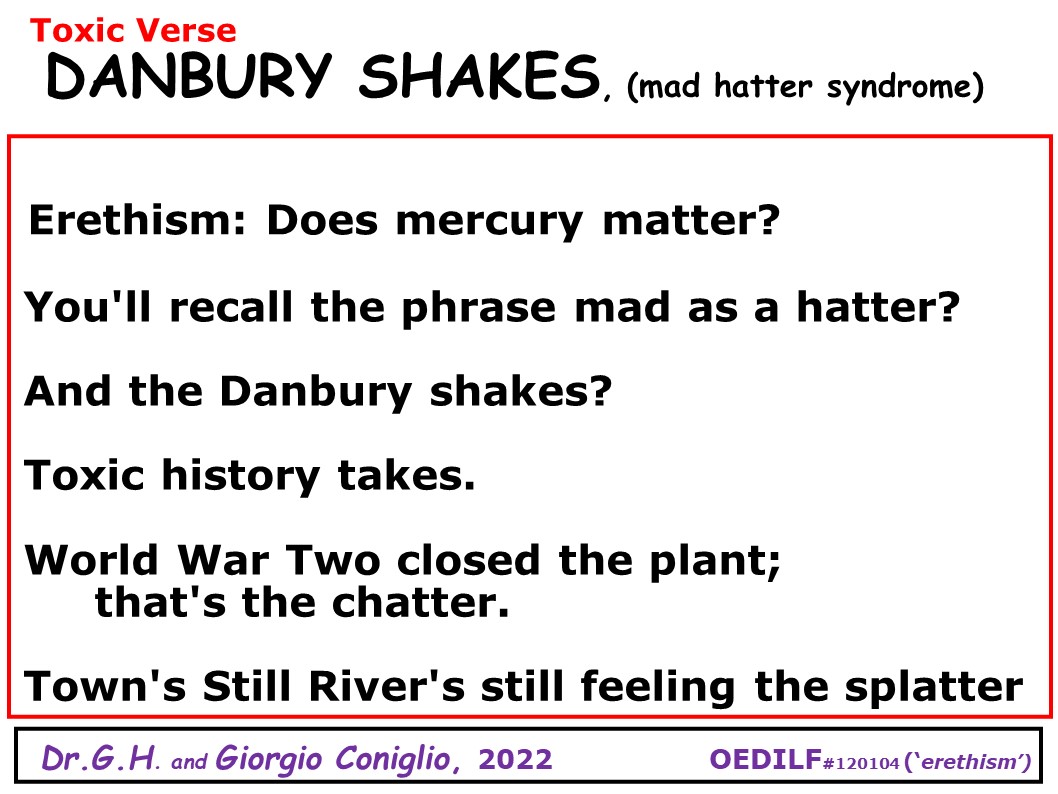
Danbury shakes (mad hatter syndrome)
Digitalis toxicity
Drugs of abuse


Authors' Note  Poisoning with sweet-smelling ethylene glycol is a common toxic problem for humans and pets owing to its wide commercial distribution in products including antifreeze and windshield washer fluid.

 Discovered in 1958, denatonium benzoate (sold under various tradenames, including Bitrex), tastes unbearably bitter to most mammals, even in low concentations, but is not apparently harmful otherwise. It has been used to prevent ingestion of a variety of consumer products. In 2012, all American manufacturers of antifreeze voluntarily agreed to add denatonium to these liquids in order to reduce fatal poisonings.


Author's Note  Anthracycline antibiotics, e.g. doxorubicin (adriamycin) are among the most effective chemotherapy agents; they have been profitably incorporated in multidrug chemotherapy treatment routines for many types of cancer. These advantages are partially offset by a relatively unique adverse effect — the possibility of cardiotoxicity, permanent impairment of the systolic (contracting) function of ventricular heart muscle. 
   Development of this side effect can be minimized by pharmacological manipulations and by monitoring cardiac function periodically during longterm treatment.
   Nuclear medicine techniques have classically been used, but echocardiography may also be of value (see the verse ‘Ejection Fraction’) in monitoring cardiac function.


Authors' Note:

(KEE-layt) / (kee-LAY-shun) Treatment with chelates or chelating agents, has several well-recognized uses in medicine. These include removal of toxic metals from the body, e.g. lead in cases of acute or chronic poisoning, and treatment of iron overload in patients who have received repeated blood transfusions to treat their chronic anemias. The search for drugs of this type which are safer and easier to use is ongoing.


  Authors' Note: Erethismus (irritation) mercurialissynonym for mercurialism, was well-known by Lewis Carroll's time, as signs of chronic poisoning had become common among workers in the hatting industry in which salts of mercury were used in the felting of furs; his character, the 'Mad Hatter' reflects the prevalent stereotype.

In the US, hat-making was centered in the Connecticut town of Danbury, where the majority of long-term workers were subject to the 'Danbury shakes' as well as other neuropsychiatric manifestations. The plant continued in operation, including the dumping of wastewater effluent, until the early 1940s. It closed at that time due to staffing shortages and the need for mercury in the armaments industry.

   In 2020, a study of fish populations in Danbury's Still River showed alarming levels of mercury; the persistence of this toxic residue reflects, in part, the concept of biomagnification. 


Authors' Note

(di-JOK-sin)

Digoxin, a cardiac glycoside derived initially from the garden plant digitalis (foxglove), has been used to treat chronic congestive heart failure and to control the heart rate in atrial fibrillation. During the author's professional lifetime, there has been a major reduction in the death-rate and in the incidence of hospital admissions for digoxin poisoning, also known as digitoxicity. This improvement is due to more judicious assessment of factors, e.g. decreasing kidney function, that may result in increasing blood levels of the drug, but also to limitation of the drug's use as alternatives have become available.  


Authors' Note:  Occasionally, the shock of reality may help a victim of substance abuse, like Seth, to focus on his plight. A more professional discussion of drug addiction by SheilaB may be enlightening.