Sunday, 20 December 2020

TOURISTS' PALINDROMIC GUIDE: The Old World #1-#6


This post represents a new direction, based on Tourists' Palindromic Guide: The Americas #1.

SATIRE COMPOSED: Dr. G.H. and Giorgio Coniglio (registered pseudonym), 2018. 
WORDPLAY LINK: Geographically focused concoctions are among the many palindromic treasures honored and displayed on this site. Check out the list of entries for "The Palindrome Suite" in the slide at the bottom of the initial post. 


Click HERE to continue to panels #7 through #12.


(Or, switch horses, and check out the palindromes from the Americas, HERE!)


GENERAL DIRECTIONS FOR WEB-EXPLORERS: 
To resume the sequence of daily titillations on our related blog "Daily Illustrated Nonsense", click HERE. Once you arrive, you can select your time frame of interest from the calendar-based listings at the bottom of the page, and check the daily offerings for any month from the start of 2020 until December 2024. 
As of December 2024, there are 1800 unique entries available on the daily blog, displaying individual poems (often illustrated) and wordplay, but also with some photo-collages and parody song-lyrics. Most of their key elements are also presented here on "Edifying Nonsense" in topic-based collections, such as this one. The "Daily" format also has the advantage of including some song-lyrics, videos and other material that are not shown here on this topic-based blog.


Tuesday, 15 December 2020

For Every Adventuality: VERSES for the FESTIVE SEASON


If you want to resume daily titillations on our blog 'Daily Illustrated Nonsense', click HERE. Once you arrive, you can select your time frame of interest from the calendar-based listings in the righthand margin, and check the daily offerings for any week in the years 2020 and 2021. (There are now over 600 daily entries on the Daily blog, and most of these are also presented here on 'Edifying Nonsense' in topic-based collections.)

Saturday, 5 December 2020

DEC 5 '20: TOXIC VIGNETTES, #1


CURRENT CONTENTS:
Antifreeze poisoning
Chemotherapy drugs, cardiotoxicity
Chelation
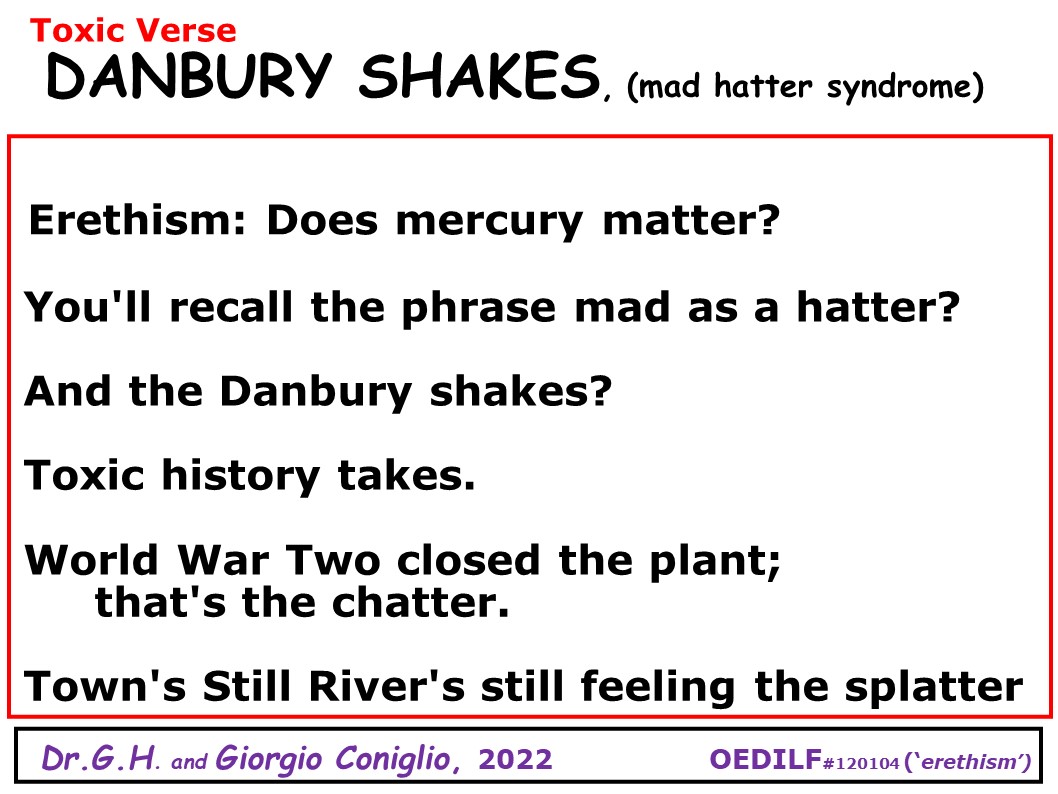
Danbury shakes (mad hatter syndrome)
Digitalis toxicity
Drugs of abuse


Authors' Note  Poisoning with sweet-smelling ethylene glycol is a common toxic problem for humans and pets owing to its wide commercial distribution in products including antifreeze and windshield washer fluid.

 Discovered in 1958, denatonium benzoate (sold under various tradenames, including Bitrex), tastes unbearably bitter to most mammals, even in low concentations, but is not apparently harmful otherwise. It has been used to prevent ingestion of a variety of consumer products. In 2012, all American manufacturers of antifreeze voluntarily agreed to add denatonium to these liquids in order to reduce fatal poisonings.


Author's Note  Anthracycline antibiotics, e.g. doxorubicin (adriamycin) are among the most effective chemotherapy agents; they have been profitably incorporated in multidrug chemotherapy treatment routines for many types of cancer. These advantages are partially offset by a relatively unique adverse effect — the possibility of cardiotoxicity, permanent impairment of the systolic (contracting) function of ventricular heart muscle. 
   Development of this side effect can be minimized by pharmacological manipulations and by monitoring cardiac function periodically during longterm treatment.
   Nuclear medicine techniques have classically been used, but echocardiography may also be of value (see the verse ‘Ejection Fraction’) in monitoring cardiac function.


Authors' Note:

(KEE-layt) / (kee-LAY-shun) Treatment with chelates or chelating agents, has several well-recognized uses in medicine. These include removal of toxic metals from the body, e.g. lead in cases of acute or chronic poisoning, and treatment of iron overload in patients who have received repeated blood transfusions to treat their chronic anemias. The search for drugs of this type which are safer and easier to use is ongoing.


  Authors' Note: Erethismus (irritation) mercurialissynonym for mercurialism, was well-known by Lewis Carroll's time, as signs of chronic poisoning had become common among workers in the hatting industry in which salts of mercury were used in the felting of furs; his character, the 'Mad Hatter' reflects the prevalent stereotype.

In the US, hat-making was centered in the Connecticut town of Danbury, where the majority of long-term workers were subject to the 'Danbury shakes' as well as other neuropsychiatric manifestations. The plant continued in operation, including the dumping of wastewater effluent, until the early 1940s. It closed at that time due to staffing shortages and the need for mercury in the armaments industry.

   In 2020, a study of fish populations in Danbury's Still River showed alarming levels of mercury; the persistence of this toxic residue reflects, in part, the concept of biomagnification. 


Authors' Note

(di-JOK-sin)

Digoxin, a cardiac glycoside derived initially from the garden plant digitalis (foxglove), has been used to treat chronic congestive heart failure and to control the heart rate in atrial fibrillation. During the author's professional lifetime, there has been a major reduction in the death-rate and in the incidence of hospital admissions for digoxin poisoning, also known as digitoxicity. This improvement is due to more judicious assessment of factors, e.g. decreasing kidney function, that may result in increasing blood levels of the drug, but also to limitation of the drug's use as alternatives have become available.  


Authors' Note:  Occasionally, the shock of reality may help a victim of substance abuse, like Seth, to focus on his plight. A more professional discussion of drug addiction by SheilaB may be enlightening.


Friday, 20 November 2020

TOURISTS' PALINDROMIC GUIDE: The Americas #4


Preview of this fall's offerings. Target date: November 10.
This post is a continuation of...
 Tourists' Palindromic Guide: The Americas #1
 Tourists' Palindromic Guide: The Americas #2
 Tourists' Palindromic Guide: The Americas #3


SATIRE COMPOSED: Giorgio Coniglio (registered pseudonym) and Dr. GH, 2018. 

WORDPLAY LINK: Panels showing palindromic phrases derived from geography of the Americas were originally displayed on Wordplay posts on this blog during the interval from 2018 to February 2019; the current examples have been developed since that time. Geographically focused concoctions are among the many palindromic treasures honored and displayed on this site. Check out the list of entries for "The Palindrome Suite". 

SONGLINK:  Some readers will be delighted (others will continue to groan) at our collection of songs based on palindromic phrases -- click the link to the initial blogpost in this series to make these links available as well.


Still want more palindromic fun? Click HERE for 'concluding remarks' about New-World and Old-World palindromes.


GENERAL DIRECTIONS FOR WEB-EXPLORERS: 
To resume the sequence of daily titillations on our related blog "Daily Illustrated Nonsense", click HERE. Once you arrive, you can select your time frame of interest from the calendar-based listings at the bottom of the page, and check the daily offerings for any month from the start of 2020 until December 2024. 
As of December 2024, there are 1800 unique entries available on the daily blog, displaying individual poems (often illustrated) and wordplay, but also with some photo-collages and parody song-lyrics. Most of their key elements are also presented here on "Edifying Nonsense" in topic-based collections, such as this one. The "Daily" format also has the advantage of including some song-lyrics, videos and other material that are not shown here on this topic-based blog.


Thursday, 5 November 2020

NOV 5 '20: Verse for HOLIDAYS and CELEBRATIONS


Authors' Note:  Poinsettia is now the common name by which this seasonal plant is known around the world.

  Joel Poinsett, South Carolinian physician and amateur botanist, served as the first US ambassador (a position designated as minister) to Mexico. In the 1820s, he sent home to his greenhouses samples of Euphorbia pulcherrima (member of the spurge family), locally known as flor de nochebuena (Christmas Eve), linked to the Hispanic nativity celebration. 
  Distribution of the poinsettia in the US was enhanced by development of cultivars with a more lush profusion of the colored bracts, and recently, by variants in other appealing colors. Today, a single nursery in Texas accounts for 70% of American sales, and half of all global sales of this decorative seasonal specialty.
  Incidentally, although the plant is assumed by many to be toxic, that possibility appears based on an incorrect original report, unsupported by other evidence.


(Note that the five verses of this "brief saga" can be found in more readily legible format on the blog "Daily Illustrated Nonsense"; click HERE.) 


GENERAL DIRECTIONS FOR WEB-EXPLORERS: 
To resume your review of the sequence of daily titillations on our related blog "Daily Illustrated Nonsense", click HERE. Once you arrive, you can select your time frame of interest from the calendar-based listings at the bottom of the page, and check the daily offerings for any month from the start of 2020 until July 2025. 
As of July 20, 2025, there are 2,000 unique entries available on the daily blog, displaying individual poems (often illustrated) and wordplay, but also with some photo-collages and parody song-lyrics. 
Most of the key elements, such as this one, are also assembled here on "Edifying Nonsense" in topic-based collections.
The "Daily" format, a formidable mix of genres, also has the advantage of including song-lyrics, videos and other material that are not shown here on this topic-based blog.

Tuesday, 20 October 2020

TOURISTS' PALINDROMIC GUIDE: The Americas #3


SATIRE COMPOSED: Giorgio Coniglio (registered pseudonym) and Dr.G.H., 2018. 

WORDPLAY LINK: The panels showing palindromic phrases derived from geography of the Americas were originally displayed on Wordplay posts on this blog during the interval from October 2018 to February 2019. Geographically focused concoctions are among the many palindromic treasures honored and displayed on this site. Check out the list of entries for "The Palindrome Suite" in the slide at the bottom of the first post on this topic.

SONGLINK: Some readers will be delighted (others will continue to groan) at our collection of songs based on palindromic phrases -- click the link to the initial blogpost in this series to make these links available as well.


Still want more palindromic fun? Click HERE to proceed to collages 37 through 48.


GENERAL DIRECTIONS FOR WEB-EXPLORERS: 
To resume the sequence of daily titillations on our related blog "Daily Illustrated Nonsense", click HERE. Once you arrive, you can select your time frame of interest from the calendar-based listings at the bottom of the page, and check the daily offerings for any month from the start of 2020 until December 2024. 
As of December 2024, there are 1800 unique entries available on the daily blog, displaying individual poems (often illustrated) and wordplay, but also with some photo-collages and parody song-lyrics. Most of their key elements are also presented here on "Edifying Nonsense" in topic-based collections, such as this one. The "Daily" format also has the advantage of including some song-lyrics, videos and other material that are not shown here on this topic-based blog.

Thursday, 15 October 2020

Limericks and Locks: The Poetry of CANALS


Swan guiding barge,
lower end of St-Martin Canal

The current offering meshes with a developing slew of map-art blogposts by Giorgio Coniglio and Dr. GH. With all this mental energy focusing backwards and forwards on palindromes, it is hard to avoid the subject of canalsAnd to help wordplay-buffs focus on palindromes about canals, here is an ancient blogpost on the subject: CANALINDROMES


...

Also, check out these collections of wordplay-maps by Dr. G.H. and Giorgio Coniglio (registered pseudonym)
 - Tourists' Palindromic Guide: The Old World #1
 - Tourists' Palindromic Guide: The Old World #2
 - Tourists' Palindromic Guide: The Old World #3
 - Tourists' Palindromic Guide: The Old World #4
and...
 - Tourists' Palindromic Guide: The Americas #1
 - 
Tourists' Palindromic Guide: The Americas #2
 - Tourists' Palindromic Guide: The Americas #3
 - Tourists' Palindromic Guide: The Americas #4

 - INTRODUCTORY CONCLUSION: The Tourists' Palindromic Guides  
as well as a didactic post explaining the origin and rationale of 


To read more about the origin, creation and listing of magical palindromes, click or cluck here to get to Giorgio's original blogpost on the topic.


DIRECTION FOR WEB-TRAVELLERS: 
To resume daily titillations on our blog 'Daily Illustrated Nonsense', click HERE. Once you arrive, you can select your time frame of interest from the calendar-based listings in the righthand margin, and check the daily offerings for any month in the years 2020 to the present. (As of February 2023, there are 1100 entries available on the Daily blog, and most of these are also presented here on 'Edifying Nonsense' in topic-based collections.)

Saturday, 10 October 2020

photo-collages; Hikes, Bikes and Likes: TORONTO RAVINES #4


 Here's more stuff about some of Toronto's hidden treasures, continuing from three previous posts entitled "Hikes, Bikes and Likes: TORONTO RAVINES" #1 , #2 and #3.

If you would also like to view the poetic outpouring inspired by these wilderness urban spaces, click HERE for "Toront-oases (verse)". 


On a sunny morning, shimmering light reflected from the Don River below highlights the canoes that constitute this art installation. It's located near the 'Elevated Uplands' under a bridge that carries Don Mills Road, near its junction with the Don Valley Expressway.


a) An eco-tourist attracted to view the "Shimmering Canoes". b) Your blog-editor visits the nearby "Elevated Wetlands" (a.k.a. "the solar molars").


Sculpture by Canadian naturalist, innovator and artist William Lishman.


If you have enjoyed these excursions through Toronto's network of ravines, you might also enjoy reviewing the city's other iconic sights -  ecologic, cultural and architectural as pictured on the blog "Toronto Oases".


DIRECTION FOR WEB-TRAVELLERS: 
To resume daily titillations on our blog 'Daily Illustrated Nonsense', click HERE. Once you arrive, you can select your time frame of interest from the calendar-based listings in the righthand margin, and check the daily offerings for any month in the years 2020 to the present. (As of February 2023, there are 1100 entries available on the Daily blog, and most of these are also presented here on 'Edifying Nonsense' in topic-based collections.)