Monday, 20 February 2023

Wordplay maps: R-E-P-U-B-L-I-C-A-N-S in Canada (anagram maps #9-12)


For more wordplay maps on this topic, click HERE.

To return to the original post, i.e. maps #1-4, click HERE.


GENERAL DIRECTIONS FOR WEB-EXPLORERS: 
To resume your review of the sequence of daily titillations on our related blog "Daily Illustrated Nonsense", click HERE. Once you arrive, you can select your time frame of interest from the calendar-based listings at the bottom of the page, and check the daily offerings for any month from the start of 2020 until July 2025. 
As of July 20, 2025, there are 2,000 unique entries available on the daily blog, displaying individual poems (often illustrated) and wordplay, but also with some photo-collages and parody song-lyrics. 
Most of the key elements, such as this one, are also assembled here on "Edifying Nonsense" in topic-based collections.
The "Daily" format, a formidable mix of genres, also has the advantage of including song-lyrics, videos and other material that are not shown here on this topic-based blog.

Wednesday, 15 February 2023

Breaking News: FUNNY BONES, fragment #2

This blogpost represents a continuation of an earlier post, entitled (not surprisingly) "Funny Bones, fragment #1". 

prior posted poems (fragment #1)
background reading: "The Orthopedic Surgeon".
communited fracture
fractured wrist (distal radius)
scaphoid fracture
anatomic snuffbox
hook of the hamate
olecranon ("funny bone")
bone alignment

CURRENT CONTENTS: (fragment #2)
Metatarsal stress fracture
Jones (5th metatarsal) fracture
Lisfranc fracture
Pelvic fracture (banker's consultation)
Heterotopic ossification
Prosthetic hipster
AVN (avascular necrosis) of the hip
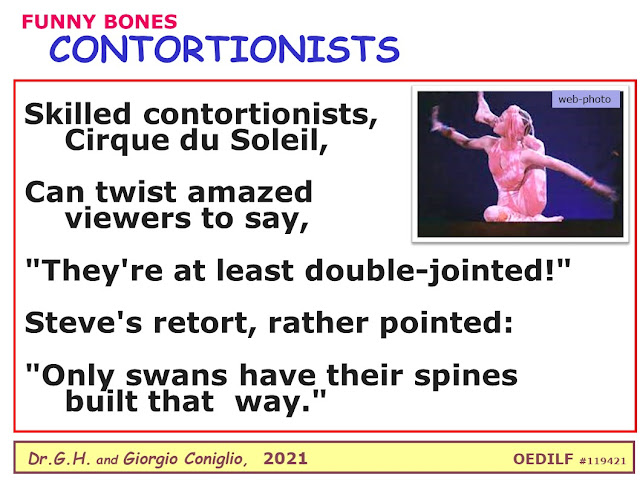
Contortionists
Enid's osteopenia


Authors' Note:  Stress fractures are injuries caused by repeated undue physical stress applied to normal bone. These injuries, sometimes called march fractures, are common in the midshafts of the bones of the forefoot, particularly metatarsals #2 through #4. They characteristically occur in military recruits and in athletic individuals with heavy training schedules, but also may show up in otherwise unremarkable individuals who have recently increased their level of physical activity. Fortunately, healing is usual in those prepared to reduce activities for a number of weeks.
    To read more about this important topic, check the online medical periodical Bone Bloggers: Opinion by Orthopedic Surgeons.


Authors' Note:  In fact, Syd has the right idea. Current therapy for the Jones fracture (which occurs due to repeated twisting stress in dancers and tennis or basketball players) includes surgical placement of a screw that binds the two fragments, to eliminate the possibility of bone non-union that complicated earlier forms of treatment. In cases where surgery is not selected, treatment usually consists of an external cast and avoidance of weight-bearing for six weeks. 


Authors' Note: 

crank: an unpleasant person who has difficulty with anger control

ORIF: acronym for surgical intervention for bone fractures — open reduction, internal fixation

plain films: medical jargon for two-dimensional x-ray studies, as opposed to CT, although digital media, not 'film' emulsion, are now generally used to analyze and record the images

With these injuries that involve one or more fractures, metatarsal bones of the lower foot are dissociated from the tarsus, making the mid-foot unstable. They were first observed in cavalry men during the Napoleonic Wars and later described by a French surgeon, Jacques Lisfranc de St-Martin. In English medical jargon they are known as Lisfranc (LIZ-frank or liz-FRANK) fractures. Self-diagnosis of this type of injury by a patient would be an unusual event


Authors' Note: 

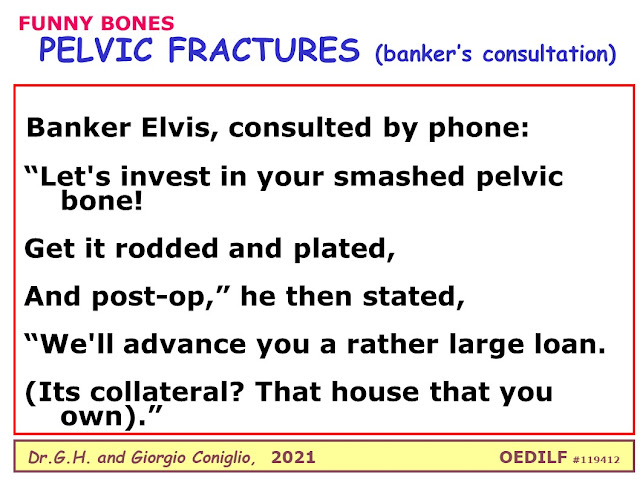
 post op: medical jargon for 'post-operative' or 'post-operatively’.

   Costs incurred by surgical care in the United States can be devastating. It is, however, unusual for bankers to be consulted directly re the affordability of urgent surgical procedures. 

  Multiple pelvic fractures involving the sacrum and/or pubic rami may accompany major trauma to the lower trunk. These can often be managed conservatively, but instability may mandate surgical fixation.  
 

Authors' Note: 

 (HET-uhr-oh-top-ic, as here, or het-uhr-oh-TOP-ic)

      Usually asymptomatic, new bone formation in extra-skeletal sites seems to occur after physical or surgical trauma, particularly in the lower limbs following joint replacement. Occasionally, within several weeks after the inciting episode, tenderness and swelling near major joints may occur, needing to be differentiated from venous blockage, and requiring bone scanning for detection, as initial radiographs may be negative; this variant syndrome is known as myositis ossificans. Rarely, in progressive cases, surgery is eventually required to allow mobility at affected joints.


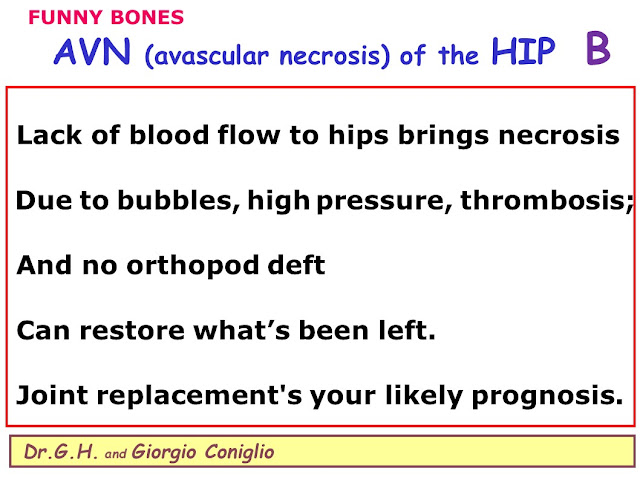
Authors' Note: Owing to impairment of blood flow, fracture of the femoral neck, a risk for active seniors, may result in the subsequent need for hip replacement. The most common cause for hip-joint replacement, however, remains osteoarthritis.


Authors' Note: The femoral head is the proximal portion of the femur (thigh bone) within the capsule of the hip joint. The blood supply to this area is fragile, and its blockage, presumably due to a variety of disease processes (often poorly understood or not obvious), can result in death of bone cells and collapse of this weight-bearing structure. In medical jargon, this process is known as "avascular necrosis". Replacement of the hip joint may eventually be needed. 

  Orthopedic surgeons (surgical bone specialists), known in medical jargon as orthopods, are involved in monitoring and treating the condition.  


Authors' Note:

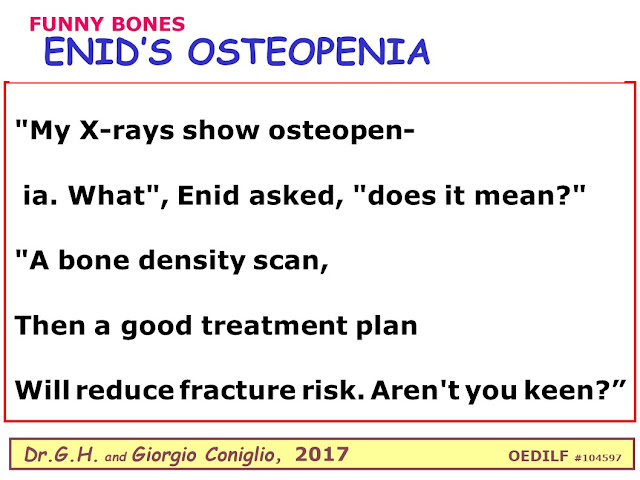
Osteopenia (ost-ee-oh-PEE-nee-yah), or reduced bone mass as suggested on regular x-ray studies, is a 'washed out' appearance raising the question of whether the patient has osteoporosis, a significant loss of bone mineral resulting in increased fracture risk. The word break in osteopenia (osteo, Latin root for ‘bone’) at the end of the first line is a reminder of its association with fracture. The DEXA test evaluates the mass of bone reproducibly, and, in the context of age and gender, helps decide on the necessity of drug treatment to prevent 'fragility fractures'. 
You can read more about the DEXA test for bone mineral density (BMD) HERE.

                    -  -  -  -  -  -  -  -  -  -  -  -  --- -- -- -- -- -- -- -- -- 
Here's a LIST OF LINKS to collections of intriguing poems (over 200 of these!) on medical/dental topics, updated to December 2024. 

GENERAL DIRECTIONS FOR WEB-EXPLORERS: 
To resume your review of the sequence of daily titillations on our related blog "Daily Illustrated Nonsense", click HERE. Once you arrive, you can select your time frame of interest from the calendar-based listings at the bottom of the page, and check the daily offerings for any month from the start of 2020 until July 2025. 
As of July 20, 2025, there are 2,000 unique entries available on the daily blog, displaying individual poems (often illustrated) and wordplay, but also with some photo-collages and parody song-lyrics. 
Most of the key elements, such as this one, are also assembled here on "Edifying Nonsense" in topic-based collections.
The "Daily" format, a formidable mix of genres, also has the advantage of including song-lyrics, videos and other material that are not shown here on this topic-based blog.


FEB !5 '23: HERPETOLOGIC (reptilian) VERSE#1: first slither

 
SATIRE COMPOSED: Giorgio Coniglio (registered pseudonym) and Dr. G.H. have prioritized excursions into the world of nature on this blog since its inception in 2016
  Today's verses have also been published at OEDILF.com
(Omnificent English Dictionary in Limerick Form), an online humor dictionary website that has accumulated over 120,000 limericks, including over 900 that we have submitted (to date, i.e. December 2024, 820 have been finally published following their customary rigorous editing process). The OEDILFian code number for the completed submission is indicated at the bottom of each of our slides. 

Incidentally, artwork including photos, as well as the poetry are the creation of this blog's author-editors (i.e. Dr.G. and Giorgio) unless otherwise indicated.   

PHOTOS: Unless otherwise noted, embedded photographs were taken with and transferred from Giorgio's cellphone, then formatted using ancient Powerpoint software. No photographic subjects were reimbursed for participating in this undertaking. 

BACKGROUND:  "herpetology" - the branch of zoology dealing with reptiles and amphibians. Readers should note that snakes have been omitted from this poetic idyll owing to the marked aversion by the editor's life-partner. 

And, for those interested here's a list of our whole collection of posts related to Nature ...

Verses about Geysers, Sep '18
Verses about Trees, Apr '19
Verses about Reptiles, Jun '19, as above,
AND, here's the lineup for future posts ... 
Verses about Waterfowl, June '19
Verses about Waterfowl (part #2), July '19
Verses about Trees (part #2), Aug '19
Verses about Waterfowl (part #3), Apr '20
Verses about Reptiles, (part #2), May '20
Verses about Waterfowl (part #4 - Loons), Aug '20.
Verses about Waterfowl (part #5), Dec '20. 


CURRENT CONTENTS (first slither):
Amphisbaenians
Autotomy
Beneficial snakes
Broad-headed skinks
Brown anoles
(for continuation, see link below) 


Authors' Note: 

clade: taxonomic term, equivalent to ‘suborder’

   The amphisbaenians are a group of reptiles named for the Greek mythological figure Amphisbaena, a two-headed serpent. Superficially resembling earthworms, but with similar markings about their tails and their small heads, they spend most of their time in a subterranean environment. Although they are  widely found in South America, the Caribbean region and Africa, their current distribution in North America and in Europe is more limited, involving only Florida and Iberia respectively.
    
   The motivation for the alleged fevered search by Slovenian crowds to find these creatures is unclear.
   The suffix -paenia, or -penia, (PEE-nyuh), not infrequently used in medical terms, indicates a lack or deficiency.


Authors' Note: 

‘The Palmetto State’: South Carolina
plenum: from the Latin for ‘full’, a deliberative meeting of a body in which all members are present, contrasted with quorum
plenumous: ad hoc neologism indicating the importance of the issue at hand

Your contributions to the BPSS, tax-free, will help us in our efforts to counter anti-social behavior in South Carolina (the palmetto state) by the following: 
eastern diamondback, timber/canebrake and pygmy rattlesnakes,
copperheads, 
cottonmouths,
coral snakes.


Nature-lovers , academic herpetologists, wordplay enthusiasts, wildlife photographers, Giorgio's relatives, and just everyday folks have united in their demand for more verses on this topic!
So, please follow this link!

GENERAL DIRECTIONS FOR WEB-EXPLORERS: 
To resume your review of the sequence of daily titillations on our related blog "Daily Illustrated Nonsense", click HERE. Once you arrive, you can select your time frame of interest from the calendar-based listings at the bottom of the page, and check the daily offerings for any month from the start of 2020 through the summer of 2026. 
As of March, 2026, there are 2,000 unique entries available on the daily blog, displaying individual poems (often illustrated) and wordplay, but also with some photo-collages and parody song-lyrics. 
Most of these key elements of our work are assembled here on "Edifying Nonsense" in topic-based collections.
The "Daily" format, a formidable mix of genres has the advantage of including song-lyrics, videos and other material that are not shown here on this topic-based blog.

Friday, 10 February 2023

True-and-Faux photos: PORTRAITS of COUPLES #3

prior post (1st group)
introduction
domestic turkeys
 -------------
armadillos
Aurora and Cephalus
basset hounds
black swans 
black-crowned night herons
black-necked swans 
broad-headed skinks 
bros
prior post (2nd group)
Canada geese 
chickens 
deer
dogpark figures 
domestic geese 1(Paris) 
domestic geese 2(Toronto) 
emus 
family - Canada geese
feral domestic ducks 
frogs 

CURRENT CONTENTS
gemsboks
goats
gorillas
g(i)roomed dogs
gulls (European herring)
Harris hawks 
hippos
horses
house finches

for continuation to the fourth group, follow the link below.


A short time after competing this series on Couples in the animal world, I rediscovered some old song-lyrics I had written for "Pairs", the introductory parody-song for a series about Word-Pairs, (based on the BeeGees' "Words"). It's a bit tangential, but you might like to review it here.


We know that you are itching to review more of this photo-portfolio. So, you can do just that by clicking the 4th group HERE


GENERAL DIRECTIONS FOR WEB-EXPLORERS: 
To resume your review of the sequence of daily titillations on our related blog "Daily Illustrated Nonsense", click HERE. Once you arrive, you can select your time frame of interest from the calendar-based listings at the bottom of the page, and check the daily offerings for any month from the start of 2020 until July 2025. 
As of July 20, 2025, there are 2,000 unique entries available on the daily blog, displaying individual poems (often illustrated) and wordplay, but also with some photo-collages and parody song-lyrics. 
Most of the key elements, such as this one, are also assembled here on "Edifying Nonsense" in topic-based collections.
The "Daily" format, a formidable mix of genres, also has the advantage of including song-lyrics, videos and other material that are not shown here on this topic-based blog.