Since 2016 Giorgio Coniglio, registered pseudonym and editor-in-chief, has been bundling collections of POETRY, WORDPLAY, PARODY-SONG LYRICS and PHOTOGRAPHY, grouped by topic, and seasoned with humour and parody. His sole aim is to entertain you with presentations five times per month. The poems have primarily been edited and approved at other online sites.The related blog "DAILY ILLUSTRATED NONSENSE" sends out items from these collections in intentionally random order one-at-a-time.
MUSICAL UNDERPINNINGS: "Big Rock Candy Mountain" is a song composed by Harry McClintock in 1928, also recorded by Burl Ives, Johnny Cash etc.
PARODY COMPOSED: Giorgio Coniglio, May 2014.
UKULELE and GUITAR-FRIENDLY LINK: Our whole series of songs can be found in a friendly format for ukulele (and guitar)-players on our sister blog "SILLY SONGS and SATIRE" with chord-charts for both the parody and original song, as well as helpful performing suggestions.
To find ukulele and guitar chord-charts to help you accompany "BIG ROB REHAB CLINIC" on your favorite instrument, click HERE.
EXPLANATION: The original song is a described as a folk music song about a hobo's version of paradise, a modern extension of the medieval concept of "Cockaigne".
PARODY COMPOSED: Giorgio Coniglio, January 2014, subsequently upgraded.
PARODY-SONGLINK: To find ukulele (and guitar) chord-charts to help you accompany "SIN and REDEMPTION" on your favorite instrument, clickHERE.
SIN AND REDEMPTION (to the tune of "He's Got the Whole World In His Hands") The Palindromes taught us, "Dennis sinned" Taught all the sisters "Dennis, Madam, sinned" Taught us "Dennis lived as a devil sinned" We're taught to know that "Dennis sinned". You've got to know that "Dennis and Edna sinned" Yes, "Dennis, Nell, Edna and Ellen sinned" "Dennis, Nell, Edna, Hannah and Ellen sinned" You know that "Dennis and Edna sinned". We're taught that "Dennis, Nora, Al, Aaron sinned" "Dennis, Nell, Edna, Gert, Reg and Ellen sinned" At "Dennis's Inn: Edna and Ennis sinned" "Dennis' tennis sin-net sinned". "Dennis, Nat's DNA and Stan? Sin, Ned" "Dennis's sensuousness? Sin, Ned" "Bed Noel, Otto, Leon, Deb" "Dennis lived at a devil's inn, Ed". Dennis "Evil did deliver, reviled did live", But if everybody here would just forgive, It could be "drawn onward" on the wind -- "Dennis never even sinned".
-------------
(Ed. Note)
Additional thoughts about the above lyrics for those so inclined:
Dennis, Enid and Nadine sinned.
Dennis, Eva, Dave sinned.
Dennis and Edna dined. Enid and Edna sinned.
Dennis, Rod, Enid and Edna dined or sinned.
Dennis and Ed, Nadine, Enid and Edna sinned.
Dennis and Ed, Nadine, Eva, Dave, Enid and Edna sinned.
This post is a continuation of 'BAR-FAUNA,as posted on this blog January 15, 2024 (part#1).
previous poetic posts(Note that captions are available for poems displayed on "Daily Illustrated Nonsense" as of 2024).
(first round):ark's bar, FUBAR/snafu), Gary the gator, Hamlet's ghostly dream, lack of enlightment, lizards' lair.
CURRENT CONTENTS (#2)
Medical watering hole
Monster-bar Mule (beasts of burden)
Organic bar Slyly
Sober October
Authors' Note: dietary: (DYE-eh-t'ree, as here, or DYE-uh-tay-ree): a hospital department best known for producing meal trays to be distributed to in-patients.
This verse is dedicated to the proposition that bars located near hospitals may be viewing-places of partiular interest. And yes! Dr. Korn is likely the medical centre's sole specialist-practitioner in his area of interest.
Authors' Note:Thegolem, an entity from Jewish folklore, is likely the least well-known of the supernatural beings participating in this story.Made entirely of inanimate matter, e.g. mud or clay, this sizable being can classically be either a victim or villain, and connotes hope or despair. In more recent popular culture, it refers to any crude automaton devised by a sorcerer.
Although she apparently has few close friends, “Nessie” is a nickname for Scotland’s famed Loch Ness monster.
Authors' Note: A mule, formerly known as a buck, makes a wonderful mixed drink on a very hot day. Its key ingredients are ginger beer (ideally the opaque soapy extract bottled in the Caribbean), citrus juice (most often freshly squeezed lime), and a variety of liquors. In the concoction’s most common form, the Moscow mule, vodka is used as the source of alcohol.
Author's Note:This verse, borrowed from OEDILF, deals with seasonal underage drinking on the Canadian prairies; click HERE.
GENERAL DIRECTIONS FOR WEB-EXPLORERS:
To resume your review of the sequence of daily titillations on our related blog "Daily Illustrated Nonsense", click HERE. Once you arrive, you can select your time frame of interest from the calendar-based listings at the bottom of the page, and check the daily offerings for any month from the start of 2020 through the summer of 2026.
As of March, 2026, there are 2,000 unique entries available on the daily blog, displaying individual poems (often illustrated) and wordplay, but also with some photo-collages and parody song-lyrics.
Most of these key elements of our work are assembled here on "Edifying Nonsense" in topic-based collections.
The "Daily" format, a formidable mix of genres has the advantage of including song-lyrics, videos and other material that are not shown here on this topic-based blog.
CURRENT CONTENTS: Atrial fibrillation Atrial flutter
Heart block
Holter monitor
Torsade de pointes
Author's atrial arrhythmia
Sinus (normal) heart beats
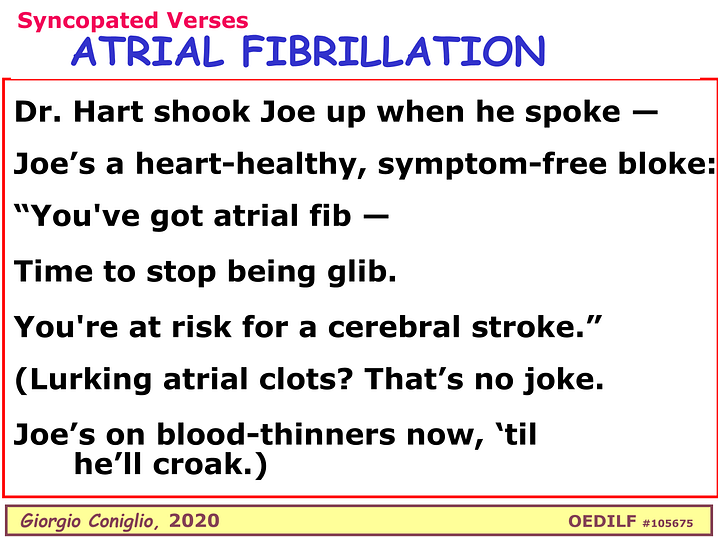
verse by the author, originally posted at OEDILF.com, about the common arrhythmia atrial fibrillation, known in medical jargon as “a-fib”
Author’s Note:Atrial fib, also abbreviated to a-fib is medical jargon for atrial fibrillation, a common arrhythmia (abnormal pattern of beating) derived from disease of the atria, the upper cardiac chambers. Definable causes for a-fib include various heart and lung conditions, particularly valvular heart disease, but half of cases occur spontaneously, particularly in the elderly. Although relatively benign compared to ventricular arrhythmias, a-fib may be associated with the formation of potentially mobile blood-clots in the atria of the heart, leading to increased risk of brain stroke.
Press enter or click to view image in full size
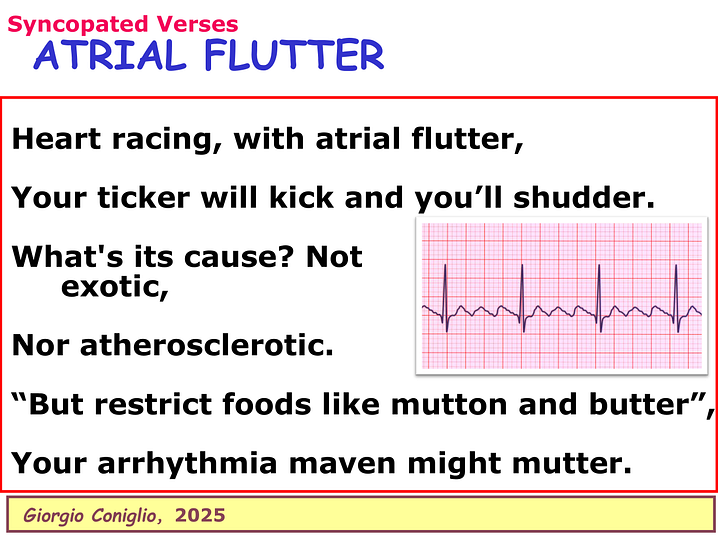
verse by the author, posted on his blog “Daily Illustrated Nonsense”, about “atrial flutter”; embedded photo, courtesy of unsplash, shows the characteristic “sawtooth” pattern of atrial P-waves, best seen when the ventricular rate is controlled
Author’s Note:Diagnosis and treatment of arrhythmias, as discussed here, is the field of endeavour of a subgroup of cardiologists (sometimes thought of, by the author as “the rhythm band”). Atrial flutter, a not-uncommon problem, is diagnosed by a regular pattern on the electrocardiogram. One sees P-waves (atrial complexes) at a rate of 300 per minute on the cardiogram, with relative block at the atrio-ventricular node resulting in a rapid but regular ventricular rate, and peripheral pulse rate often about 150 beats per minute. Symptoms include chest sensation of palpitations and general weakness. Atrial flutter is not routinely associated with coronary artery disease.
Press enter or click to view image in full size
verse by the author as posted on his personal blog “Daily Illustrated Nonsense”, about “heart-block”, a common rhythm problem for which placement of a permanent cardiac pacemaker may be curative
Author’s Note:The bundle of His (pronounced HISS), as it is best known, is an important part of the heart’s electrical conduction system, described by anatomist Dr. Wilhem His Jr. (1864–1934). Abnormal function of this tissue is a major cause of heart block.
Press enter or click to view image in full size
verse by the author, originally posted on his personal blog, about the cardiologic diagnostic tool “Holter monitor”; in the case shown in the embedded photos, 10 days of monitoring, during which the author/patient remained free of unusual sensations, revealed no evidence of arrhythmia (abnormal rhythm)
Author’s Note:Although cardiac arrhythmias, either too fast (tachycardia) or too slow (bradycardia), may be life-threatening, they are hard to pin down as they oftentimes are initially transient. Episodes are not necessarily intensely symptomatic, and most often occur outside the doctor’s office. The Holter monitor, a type of portable electrocardiogram, allows the continuous collection of a patient’s cardiac rhythm for a period of at least a day with the patient’s concurrent recording of possible related symptoms, and subsequent timely software-enhanced diagnostic interpretation of the recorded tracings.
The Holter monitor, embodying concepts conceived during investigation of radio telemetry by experimental physicists including Norman J. Holter, was released for medical application in 1962.
Press enter or click to view image in full size
verse by the author, originally posted at OEDILF.com, about a nasty type of “ventricular arrhythmia” ( a disorder of heart rhythm originating in the ventricles or lower cardiac chambers)
Author’s Note:Torsade de pointes (tor-sad duh PWAnT) or twisting of the peaks, named in 1966 by its French discoverer, is an abnormal pattern seen on the ECG, characterized by ‘twisting’ or cycling of the height of the ventricular ‘QRS’ complexes, and is often associated with inherited or acquired factors that inappropriately widen the ‘Q-T’ interval on the tracing. This unusual pattern of individual beat complexes is associated with nasty ventricular arrhythmias (beat irregularity) and sudden death. If you are lucky, you have survived the initial episode and have correctable factors (e.g. electrolyte disorders, certain pharmaceuticals, etc.).
Flying straight is a casual metaphor associated with performing expected or routine function.
Press enter or click to view image in full size
verse concocted by the author, and embedded photo in relation to his experience of a few days ago; with a diagnosis of intermittent atrial fibrillation, he is now treated with an oral anticogulant and oral beta-blockers
Author’s Note: This is a true account of a medical encounter in which the author recently participated. Atrial fibrillation, although often a persistent condition, may be an intermittent phenomenon experienced by a patient. Usually such persons, when their pulse is regular and normal in frequency will have no symptoms and no abnormalities of the cardiac complexes on their ECG. Also, for part of the time they are subject to irregularities in heart-rate and rhythm, there will not be definite symptoms. Holter monitoring, now technically possible for periods of several weeks, may be useful in uncovering these subtle episodes, particularly those occurring during sleep or distracting activities. Nonetheless, even intermittent atrial fibrillation subjects the patient to an increased risk of cerebral stroke and to the physical dangers induced by the weakness and dizziness that may accompany significant tachycardia.
In the author’s case, his history, extending over a decade, of brief and infrequent episodes of transiently irregular pulse-rate, had finally been clarified by ECG recordings. The embedded photo in the final verse confirmed the finding of intermittent atrial fibrillation. In the most recent episode, the pattern persisted for most a day, with ventricular rate persisting at over 130 beats per minute, verified by hours of monitoring in the Emergency Room. But the pattern reverted to “sinus rhythm” spontaneously, just as he was about to be pharmacologically treated for ventricular rate-control.
Press enter or click to view image in full size
verse concocted by the author to explain and exemplify the confusing medical jargon ” sinus rhythm” for an ECG tracing that displays a normal heart rate; the embedded photo show a portion of a normal 12-lead tracing obtained from the same subject as on the previous slide
Author’s Note:The sino-atrial node is a small focus of specialized cardiac tissue situated in the right atrium near the entry of the vena cava. It has auto-excitatory properties, initiating electrical impulses that travel through the atria. In humans at rest, the baseline rate averages 50 to 80 per minute, but is influenced by its nerve supply from the autonomic nervous system, e.g. during exercise.In the absence of disease, the rate is presumed to be controlled by this intrinsic “pacemaker of the heart”, hence the jargony term “sinus rhythm”. The sino-atrial node, you might note, has nothing to do with China.
To clarify another area of linguistic confusion, here’s the lowdown on names for some cardiology tests that you might hear — used by your arhythmia consultant or their residents (trainees).
ECG (electrocardiogram): the commonly used term internationally to describe the standardized tracing of electrical activity based on 12 surface (i.e. skin) leads. And the exercise ECG is usually termed a “stress test”.
EKG (elektrokardiogramm, in German): exactly the same test as above, but the original German name seems to have gotten stuck there, and is still used predominantly in the USA (Go figure!)
“echo” (echocardiogram): video images of the heart obtained with ultrasound. A newer test compared to the ECG, it never had an initialism etablished (if you try to use EHG, you won’t be understood!) Also, if this one’s done with exercise stimulation, it’s called a “stress Echo”.


 Then go home for the Election.


 And the waiters call you Coach.”
 Guess the coke should really go