This post is a continuation of the collection of poems 'English Survey Course' as displayed on this blog March 15, 2022 (part #1).
previous poetic posts (Note that captions are available for versions of the poems displayed on "Daily Illustrated Nonsense" since January 2024).
(part #1): pass/fail, Hamlet Prince of Denmark, La Belle Dame sans Merci, The Raven, Diary ofd Samuel Pepys.
CURRENT CONTENTS (#2)
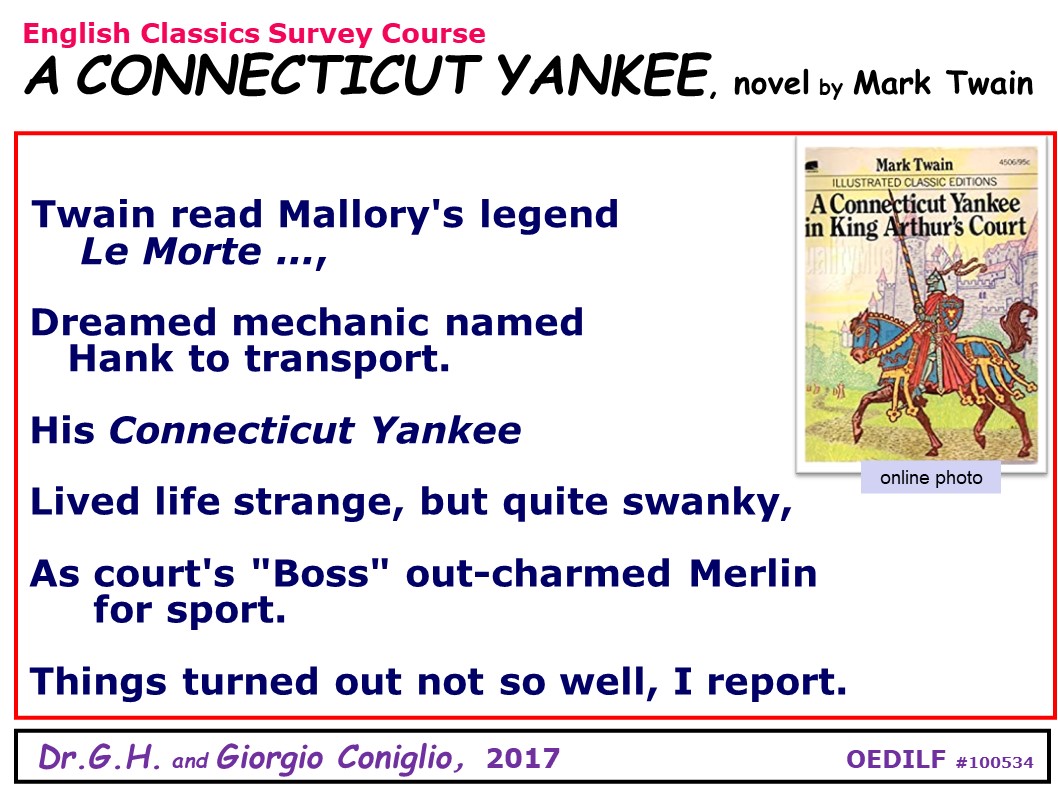
"A Connecticut Yankee"
"Jabberwocky"
"Paradise Lost"
Authors' Note: The concept for a classic literary satire began in 1884 when author Mark Twain (real name Samuel Clemens) read Le Morte d'Arthur (the Death of Arthur) by Sir Thomas Mallory, a classic romance about the knights of the Round Table.
In Twain’s fictional account, published 1889, action unfolds when Hank, a 19th century munitions-factory mechanic, awakens from a head injury to find himself amidst the sorcerers and knights at Camelot. As he rises to high rank in medieval society through manipulation of modern technology, he becomes known simply as "Boss".
Authors' Note: The noun-form of the adjective essential, used almost exclusively in the plural, exemplifies pluralia tantum, and indicates what is truly needed (Credentials, similarly, is an example of that grammatical curiosity). Paradise Lost, the epic poem about the Fall of Man and the Garden of Eden, by 17th-century English poet John Milton (1608–1674). is contained in twelve books. Its review by young literature students is aided by student guides such as Cliff's Notes.
Authors' Note: The noun-form of the adjective essential, used almost exclusively in the plural, exemplifies pluralia tantum, and indicates what is truly needed (Credentials, similarly, is an example of that grammatical curiosity). Paradise Lost, the epic poem about the Fall of Man and the Garden of Eden, by 17th-century English poet John Milton (1608–1674). is contained in twelve books. Its review by young literature students is aided by student guides such as Cliff's Notes.


No comments:
Post a Comment