This blogpost represents continuation of earlier posts, entitled (not surprisingly) 'FUNNY BONES, fragment #1', (displayed on May 5, 2024), and 'FUNNY BONES, fragment #2', (displayed on May 5, 2025).
prior posted poems
(fragment #1)
background reading: "The Orthopedic Surgeon", comminuted fracture, physiotherapy street, contortionists, Enid's osteopenia, heterotopic ossification. fractured wrist (distal radius), scaphoid fracture, anatomic snuffbox, hook of the hamate, olecranon ('funny bone').
CURRENT CONTENTS: (fragment #3)
Metatarsal stress fracture
Jones (5th metatarsal) fracture
Lisfranc fracture
Pelvic fracture (banker's consultation)
Prosthetic hipster
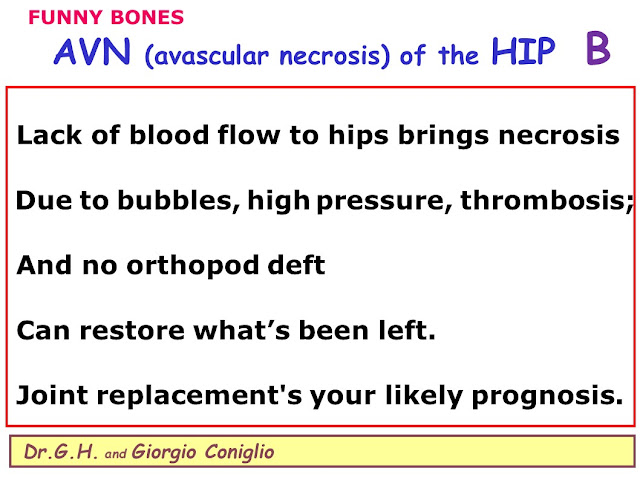
AVN (avascular necrosis) of the hip
Authors' Note: Stress fractures are injuries caused by repeated undue physical stress applied to normal bone. These injuries, sometimes called march fractures, are common in the midshafts of the bones of the forefoot, particularly metatarsals #2 through #4. They characteristically occur in military recruits and in athletic individuals with heavy training schedules, but also may show up in otherwise unremarkable individuals who have recently increased their level of physical activity. Fortunately, healing is usual in those prepared to reduce activities for a number of weeks.
To read more about this important topic, check the online medical periodical Bone Bloggers: Opinion by Orthopedic Surgeons.
Authors' Note: In fact, Syd has the right idea. Current therapy for the Jones fracture (which occurs due to repeated twisting stress in dancers and tennis or basketball players) includes surgical placement of a screw that binds the two fragments, to eliminate the possibility of bone non-union that complicated earlier forms of treatment. In cases where surgery is not selected, treatment usually consists of an external cast and avoidance of weight-bearing for six weeks.

Authors' Note:
crank: an unpleasant person who has difficulty with anger control
ORIF: acronym for surgical intervention for bone fractures — open reduction, internal fixation
plain films: medical jargon for two-dimensional x-ray studies, as opposed to CT, although digital media, not 'film' emulsion, are now generally used to analyze and record the images
With these injuries that involve one or more fractures, metatarsal bones of the lower foot are dissociated from the tarsus, making the mid-foot unstable. They were first observed in cavalry men during the Napoleonic Wars and later described by a French surgeon, Jacques Lisfranc de St-Martin. In English medical jargon they are known as Lisfranc (LIZ-frank or liz-FRANK) fractures. Self-diagnosis of this type of injury by a patient would be an unusual event
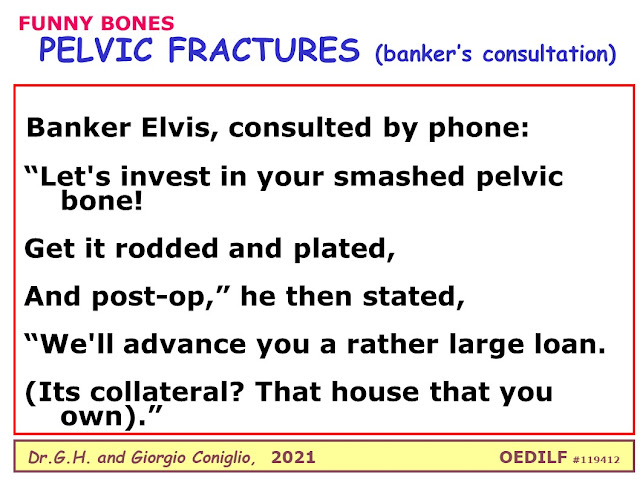
Authors' Note:
post op: medical jargon for 'post-operative' or 'post-operatively’.
Costs incurred by surgical care in the United States can be devastating. It is, however, unusual for bankers to be consulted directly re the affordability of urgent surgical procedures.
Multiple pelvic fractures involving the sacrum and/or pubic rami may accompany major trauma to the lower trunk. These can often be managed conservatively, but instability may mandate surgical fixation.
Authors' Note: Owing to impairment of blood flow, fracture of the femoral neck, a risk for active seniors, may result in the subsequent need for hip replacement. The most common cause for hip-joint replacement, however, remains osteoarthritis.
Authors' Note: The femoral head is the proximal portion of the femur (thigh bone) within the capsule of the hip joint. The blood supply to this area is fragile, and its blockage, presumably due to a variety of disease processes (often poorly understood or not obvious), can result in death of bone cells and collapse of this weight-bearing structure. In medical jargon, this process is known as "avascular necrosis". Replacement of the hip joint may eventually be needed.
Orthopedic surgeons (surgical bone specialists), known in medical jargon as orthopods, are involved in monitoring and treating the condition.
GENERAL DIRECTIONS FOR WEB-EXPLORERS:
To resume your review of the sequence of daily titillations on our related blog "Daily Illustrated Nonsense", click HERE. Once you arrive, you can select your time frame of interest from the calendar-based listings at the bottom of the page, and check the daily offerings for any month from the start of 2020 through the summer of 2026. As of March, 2026, there are 2,000 unique entries available on the daily blog, displaying individual poems (often illustrated) and wordplay, but also with some photo-collages and parody song-lyrics.
Most of these key elements of our work are assembled here on "Edifying Nonsense" in topic-based collections.
The "Daily" format, a formidable mix of genres has the advantage of including song-lyrics, videos and other material that are not shown here on this topic-based blog.




No comments:
Post a Comment