Monday, 30 March 2026

Mar 30, '26: EDITORIAL NOTICE


STOP THE PRESSES! (breaking news!)
Readers will likely have read the notice that as of July  2025, "Daily Illustrated Nonsense" will be converted to archive-mode, i.e. some polishing of presented posts will go on in the background, but there will generally be much less brand-new material presented.  
Regrettably, for the same reasons, further regular posting of new material on the current topic-based blog ("Edifying Nonsense") will also be slowing down, with sporadic exceptions. There will be some polishing and rearranging going on in the background (we have a few 'postholes' to fill in). Hence, it may still be worth your while to return and explore, to satisfy your yearning for funky humor and erudition. Thanks for your indulgence!

As time goes on, our creative impulses will be directed primarily at the song-lyric blog "Silly Songs and Satire". It already offers almost 200 songs with parody-lyrics, and accompanying chord suggestions for stringed instruments such as ukulele. 
See y'all there! 


GENERAL DIRECTIONS FOR WEB-EXPLORERS: 
To resume your review of the sequence of daily titillations on our related blog "Daily Illustrated Nonsense", click HERE. Once you arrive, you can select your time frame of interest from the calendar-based listings at the bottom of the page, and check the daily offerings for any month from the start of 2020 until the present.
As of December 30, 2026, there will be 2,100 unique entries available on the daily blog, displaying individual poems (often illustrated) and wordplay, but also with some photo-collages and parody song-lyrics. 
Please verify our math  ...
 30 posts per month X 5 years (2020 - 2024)        =   1800 posts 
 15 posts per month X 1 year (2025)                  =    180 posts
 10 posts per month X 1 year (from Jan 2026)      =     120 posts 

Collections are also assembled here on "Edifying Nonsense" in topic-based groups.
The "Daily" format, a formidable mix of genres, also has the advantage of including song-lyrics, videos and other material that are not shown here on this topic-based blog.


Wednesday, 25 March 2026

) MAR 25 (2026) singable satire: 'SATURDAY NIGHT"

 ORIGINAL PARODY-LYRICS

MUSICAL UNDERPINNINGS:

ORIGINAL SONG#1:  "Yesterday", Beatles song written for the album Help!, Paul McCartney, 1965. 
ORIGINAL SONG#2: "Saturday Night's Alright (For Fighting)" Elton John, lyrics by Bernie Taupin, 1973. 

PARODY COMPOSED: Giorgio Coniglio, August, 2015.

UKULELE and GUITAR-FRIENDLY LINK: Our whole series of songs can be found in a friendly format for ukulele (and guitar)-players on our sister blog "SILLY SONGS and SATIRE" with chord-charts for both the parody and original song, as well as helpful performing suggestions. 

To find ukulele chord-charts to help you accompany
 "Saturday Night?" on your favorite instrument, click HERE. 
You can also view the lyrics and commentary (without images or chords) displayed on a parody-lyrics website where they were first developed at AmIRight.com Post 

Note on the Parody lyrics: Among Oscar Wilde's most famous sayings, “Work is the curse of the drinking classes”

SATURDAY NIGHT as sung by the "Beatles" 

(to the Beatles' tune, "Yesterday")


Verse:
[C9] Getting late..  [Bm7]
Wanna [E7]  little action [Am] on my [Am9] plate [C9]
[F6] Ma, your [G7] discipline just [C] aggravates
[G] I [Am7] want to [D7] rock; where [F] are my [C] mates?

Chorus:
[Bm7] Set [E7] this [Am]dance [C9] a[F6]light
It’s al[G]right; we’re [G7] gonna [C] fight. [C9] [C]
[Bm7] I’ll [E7] do [Am] some[C9]thing [F6] wrong,
Then be [G] strong to [G7] set things [C] right! .[Csus4] [C9] 

[Am7] Satur[D7]day's the [F] night I [C9] like 
[Am7] Mm mm [D7] mm mm [F] mm mm [C9] mm 

Elton John Ending
[C] Saturday, Saturday, Saturday
[Bb] Saturday, Saturday, Saturday
[F] Saturday, Saturday, Saturday night's al[C]right


Getting late
Wanna little action on my plate
Ma, your discipline just aggravates
I wanna rock; where are my mates?

Sis looks cute
Hair all greased up, in her dancing-boots
Seven bells, my old man’s really juiced,
That monkey; Ma don’t give a hoot.

Saturday
It’s alright for fightin’; play that game!
I’ll be oiled as a diesel train
A beer-filled belly; why refrain?

Set this dance alight
It’s alright; we’re gonna fight.
I’ll do something wrong,
Then be strong to set things right!

Stubbornly
I’ll use muscle to get what I need
Find some dolly hanging over me,
From shadows shout out, “She’s with me!”

Party night
It’s a night whose sounds I really like 
Like a switchblade and a motorbike
Wilde’s ‘drinking class’ – I’m just its tyke.

Saturday’s the night I like!
Mm mm, mm mm, mm mm-mm.
 
(to the Elton John tune)

Saturday, Saturday, Saturday
Saturday, Saturday, Saturday night’s alright.

(back to the Beatles' tune)

Saturday's the night I like.

These lyrics have been moved, along with ukulele chord suggestions, to a posting on our song-blog "Silly Songs and Satire".

Friday, 20 March 2026

) MAR 20 (2026) singable satire: 'ALLITERATIVE BINOMIALS' part #1 ( A to K)


ORIGINAL SONG: "The Elements", Tom Lehrer, 1959.
Occasional binomials show alliteration
(e.g. one and only)

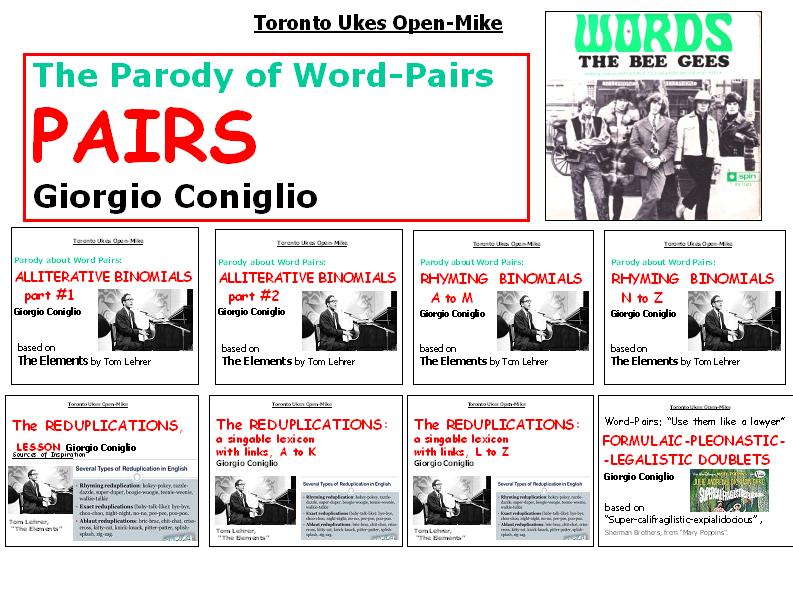
PARODY COMPOSED: Dr. G.H. and Giorgio Coniglio, 2015. This song is the second of nine in the series on Word-Pairs. You can find the links to the lyrics of the previous songs at the bottom of the post. 

EXPLANATION: The current effort involves a linguistic device discussed by Wikipedia as “Siamese twins” or ‘Irreversible Binomials”. These 
phrases include some of the most colorful expressions in English. There are probably a thousand binomial expressions in the English language. To enhance the singability, I have skewed my selection of binomial pairs here, to emphasize those that have alliteration of the 2 elements. 
For  a recently revised discussion of binomials, click HERE; there is also a post that honors our earlier exploration of these intriguing expressions entitled "The Allure of Word-Pairs: Alliterative Binomials (compendium)".

UKULELE and GUITAR-FRIENDLY LINK: Our whole series of songs can be found in a friendly format for ukulele (and guitar)-players on our sister blog  "SILLY SONGS and SATIRE". Click HERE to proceed to this site. 


Word-pair partners start together, help each other, aid — abet,
With black and blue, and beg or borrow, grasp and grab and gain and get.
Like bits and bytes, and bag and baggage, belles and beaus, and do or die,
And birds and bees, and bed and breakfast, born and bred, and crib and cry.

There’s cute and cuddly, cash or carry, big — bad — bold and beautiful,
Command — control, and bread and butter, dos and don’ts, and dutiful,
And clap and clamor, crass and crude, and drunken and disorderly,
And dear departed, dark and dank, and devil and the deep blue sea.

There’s dribs and drabs, and Dungeons — Dragons, dusk ’til dawn, all day and night,
With each and every dine and dash there’s fast and furious fight or flight.
And eyes and ears, and down and dirty, first and foremost, drink and drive,
And fun and frolic, friend or foe, and feast or famine, four or five.

With form and function, fact or fiction, fling (past flung’) — flirta-ation,
And foppery and frippery, and leisure relaxa — ation,
For flee and fly, the flor’ and fauna, flew through flaw, the flies and fleas,
No farm nor factory
, fish nor fowl,
gives grins and giggles, life of ease.

There’s gruff and grim, and ghosts and goblins, Hell — high water, good as gold,
And guys and gals, and house and home, and hoot and holler, have and hold.
Too hot to handle, his and hers, and hems and haws, and heiress — heir,
Horse — hounds, and hale and hearty, hot and heavy, neither hide nor hair.

There’s hassle — hurry, fire and fury, add insult to injury,
And judge and jury, jams and jellies, sugared Spice Girls — gingery.
And Jack and Jill, and Jew and Gentile, juke and jive, and jeer and joke;
Kit and caboodle, king and country, kill or cure, and kith — kin-folk.

There’s likely lots of others, but so far I can’t imagine ’em —
They’d spread across the alphabet from A (aardvark) to zymogen.


Sunday, 15 March 2026

MAR 15, 2026: Unprecedented doggerel: PRESIDENTIAL PALINKUs

CURRENT CONTENTS
Politics
Global warming
45th prez #1
45th prez #2
45th prez #3
45th prez #4
45th prez #5
45th prez #6
45th prez #7


Click below for collections of posted palinkus, as available uniquely on our blogs (most recently for the period of January to August 2024).

GENERAL DIRECTIONS FOR WEB-EXPLORERS: 
To resume your review of the sequence of daily titillations on our related blog "Daily Illustrated Nonsense", click HERE. Once you arrive, you can select your time frame of interest from the calendar-based listings at the bottom of the page, and check the daily offerings for any month from the start of 2020 through the summer of 2026. 
As of March, 2026, there are 2,000 unique entries available on the daily blog, displaying individual poems (often illustrated) and wordplay, but also with some photo-collages and parody song-lyrics. 
Most of these key elements of our work are assembled here on "Edifying Nonsense" in topic-based collections.
The "Daily" format, a formidable mix of genres has the advantage of including song-lyrics, videos and other material that are not shown here on this topic-based blog.


Tuesday, 10 March 2026

MAR 10, 2026: Poems about POSTAL PLACES, CANADA [8]

 DISCLOSURE: This effort got started a short time ago, when we resolved that we should write a brief verse about a town in every state in the USA. Shortly after the project's inception, we decided that we would extend the purview simultaneously to include a similar number of vignettes about lesser-known places in the provinces and territories of Canada. The Canadian inception, with eight fun-packed verses, is presented here. (Click THIS LINK if you want to see how the American branch of the project is going.)


CURRENT CONTENTS:
Antigonish, NS
Deseronto, ON
Goose Bay (and Gander), NL
Grande Prairie, AB
La Tuque, QC
Paris, ON
Red Deer, AB
Whistler, BC 
               

Authors' Note: NS is the official abbreviation for the Canadian province of Nova Scotia, in which the town of Antigonish, population 4,700, is located on the shore of Northumberland Strait, a source of excellent local seafood.

Based on an aboriginal Mi'kmak name, the town was founded in 1784 by a land grant from the British crown. It is now the home of the annual Antigonish Highland Games, and of Sir Francis Xavier University, highly reputed on a national level for undergraduate teaching.


Authors' Note: ON is the official abbreviation for the Canadian province of Ontario, in which the village of Deseronto, population 1800, is situated 5 km (3 miles) south of Highway 401, a limited-access four-lane main route that leads from Toronto to Montreal.

Captain John Deseronto, a native Mohawk, fought in the British Military Forces during the American Revolutionary War. Until 1848, "Deseronto", a site along the northern shore of Lake Ontario, served as an indigenous reserve.

Incidentally, although many characters in American western movies said "Let's vamoose!", the Lone Ranger was better known for voicing, "Hi Yo Silver, away."


 Authors' Note: NL is the official abbreviation for the Canadian province comprised of the Atlantic island of Newfoundland, and Labrador — the sparsely populated section of mainland Canada that borders the Atlantic Ocean to its north.

Gander, population 12,000, located on the island north of the capital of St John's, had been founded in the 1930s as a refuelling stop for the expanding number of commercial transatlantic flights. It recently became famous as the recipient town for diverted passenger aircraft during the 9/11 debacle.

The town of Goose Bay, population 8,000, now administratively known as Happy Valley - Goose Bay, is the largest settlement in the icy northern portion of the province. Founded in 1941, it was selected for its potential as a military airbase, and served that function throughout World War Two.

A terse story about "dangerous": A recent novice visitor from France, flying overnight to Toronto, sleepily noted the key towns on the plane's route-map, and wondered why "Danger" was prominently displayed near the country's east coast.


Authors' Note: The above verse combines three disparate plot-elements: limericks about bar jokes, our verses on North America's postal places, and the approach of Hallowe'en.

If you want to know more about the Canadian province of Alberta, consult our verse on Red Deer, AB, or ask speedysnail, author of the OEDILFian poem Alberta.


Authors' Note:  QC is the official abbreviation for the Canadian province of Quebec, in which La Tuque, population 11,000, is situated beside the St-Maurice River, 170 km (105 miles) north of the Saint Lawrence. The town's iconically shaped low mountain, resulting in its name (Fr. tuque is a soft wool hat), was partly destroyed in construction of a hydro-electric installation 80 years ago.

In each of the Canadian provinces of Quebec and Ontario, administrative rearrangements resulted in a handful of "cities" and "regional municipalities" with extensive areas that had low population densities, contrary to the usual expectation for urban centres. In this regard La Tuque heads up the pack, its central town surrounded by a vast forested area of 28,000 km2 giving it a population density of 0.4/km2, compared to Montreal, QC, and Quebec City, QC, with densities of 2,700 and 1,600/km2 respectively.


Authors' Note: 

fini (fee-NEE): occasionally used French loanword to emphatically indicate 'finished'

ON is the official abbreviation for the Canadian province of Ontario, in which the town of Paris, (population in 2024 of 15,000), is situated on the Grand River 110 km (70 miles) west of Toronto.
 
Gypsum, a partly hydrated sulphate salt of calcium, is used after pulverizing to form rigid structures that set on wetting. Plaster of Paris, a prized form of gypsum, originally found in deposits in France, has been widely used in surgical casts for broken bones. 

Paris, with its preserved Victorian architecture, was flagged as "Canada's prettiest town" by an international travel magazine. The town's name presumably derives from development of the townsite, in the mid-nineteenth century, to exploit the nearby gypsum deposits, not from involvement of French-speaking settlers nor any other French connection.

Francophones, comprising 5% of the province's total population, make up the majority of inhabitants of a few small towns in other regions of Ontario; surprisingly, some of these places have unequivocally Anglophone names including Hearst, Hawkesbury, and Moonbeam.


Authors' Note: AB is the official abbreviation for the Canadian province of Alberta, in which the city of Red Deer, population 100,000, is located mid-way between the province's two main cities of Calgary and Edmonton.

Prior to the arrival of European settlers, aboriginals had called a local stream "Elk River". European settlers renamed it as "Red Deer River" after the more familiar Eurasian species, and founded a village there in 1894, at a river crossing used by Fort Normandeau, a stockade stronghold in the Northwest Rebellion of 1885. The town of Red Deer expanded dramatically during the 1940s owing to the discovery of major Albertan oil and natural gas reserves.


Authors' Note: BC is the official abbreviation for the Canadian province of British Columbia in which the resort-municipality of Whistler, permanent population 14,000, is located. Two million tourists visit Whistler annually for winter alpine sports, and for the summer pastimes of hiking and mountain biking.

Prior to European settlement, the site was the shared territory of the Squamish and Lil'wat First Nations. Trappers and prospectors were gradually attracted, but completion of the Pacific Great Eastern Railway in 1914 provided easy access from Vancouver, and brought logging and escalating tourism. The resort-city is named for the call of the hoary marmot, a ground squirrel dwelling at high elevations. The Whistler-Blackcomb area served as a major venue for "Vancouver 2010", the twenty-first Olympic Winter Games.


You can read more about the hoary marmot in another of our verses by clicking HERE.


GENERAL DIRECTIONS FOR WEB-EXPLORERS: 
To resume your review of the sequence of daily titillations on our related blog "Daily Illustrated Nonsense", click HERE. Once you arrive, you can select your time frame of interest from the calendar-based listings at the bottom of the page, and check the daily offerings for any month from the start of 2020 through the summer of 2026. 
As of March, 2026, there are 2,000 unique entries available on the daily blog, displaying individual poems (often illustrated) and wordplay, but also with some photo-collages and parody song-lyrics. 
Most of these key elements of our work are assembled here on "Edifying Nonsense" in topic-based collections.
The "Daily" format, a formidable mix of genres has the advantage of including song-lyrics, videos and other material that are not shown here on this topic-based blog.