Tuesday, 10 September 2024

SEP 10 '24, INSECTS, buzzwords#2


    This post is part of a continuing collection of poems about 'INSECTS', as previously presented on this blog on September 5, 2022 (buzzword #1)

previous poetic posts (Note that captions are available for poems displayed on "Daily Illustrated Nonsense" in slide format since January, 2024).

(first buzzwords) (#1) beerbugs, bumblebees, clothes moths, cold adaptation, computer bugs.


CURRENT CONTENTS (#2):
Deer- and horse- flies
Entomologists
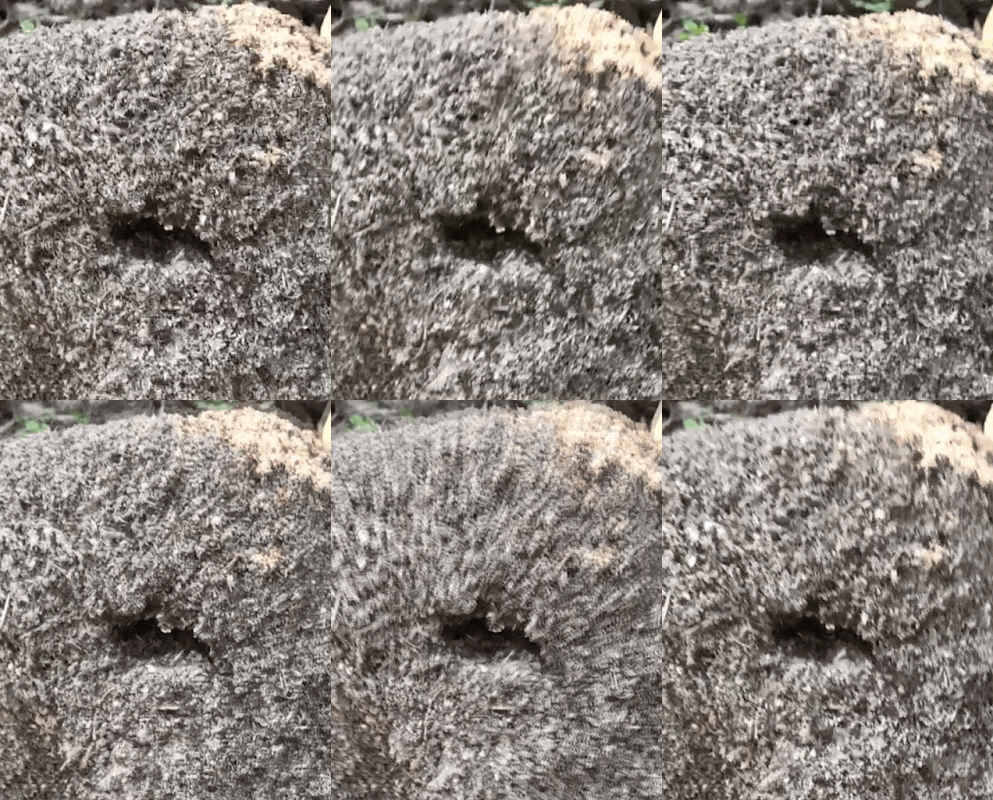
Fire Ants
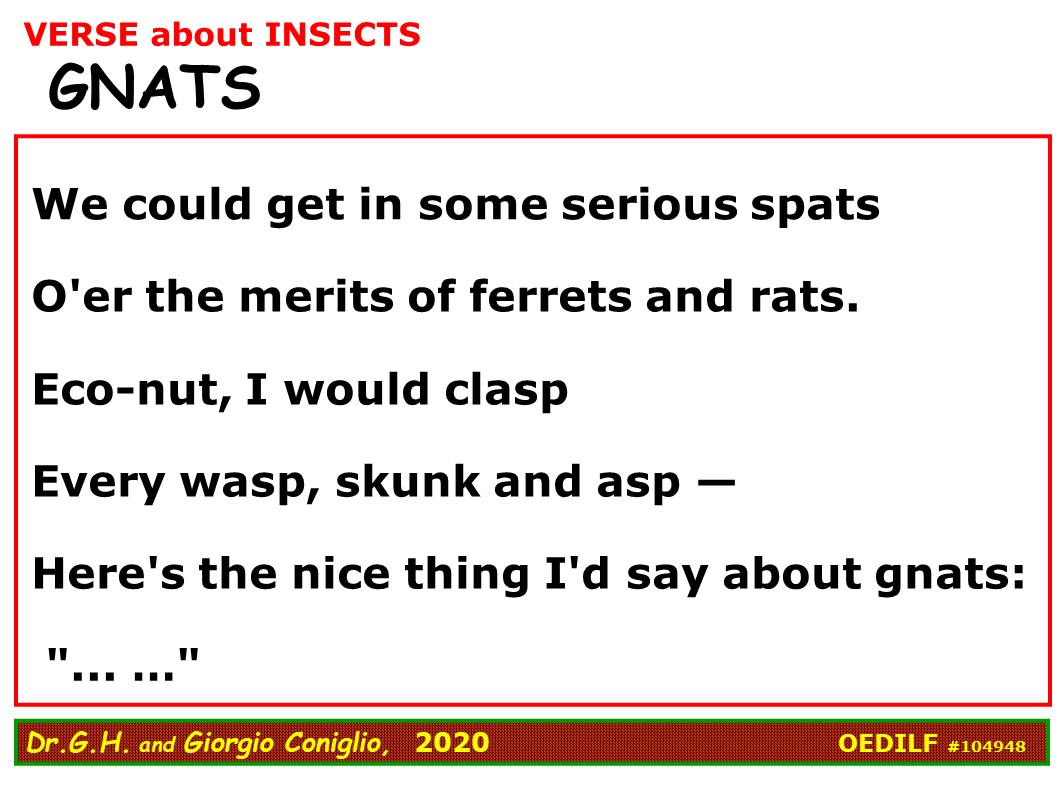
Gnats
Gnat repellents.


Authors' Note: Fact-sheets dealing with related key information have been posted on this blog by etymologists. These include short poems pertaining to insects that eat woollens, scavenge for food, destroy wood structures, prey on human blood and torment domestic pets.

Readers are advised to exercise care in distinguishing entomologists from etymologists.


Authors' Note: The authors note, with regret, and with continuing scratching of their inflamed ankles, the opening of the 'fire ant season'.  


Even in the winter, they can be activated.
Watch out!

Learn more about the red imported fire ant (RIFA) at Wikipedia.


Authors' Note  The term 'gnat' can be used to described a variety of small, swarming flies. Owing to their small size, the sort that bite are often known as 'no see 'ums'. There is a companion piece to this verse 'gnat repellent' that extends the details of this topic.    


Authors' Note:  For several decades, there has been a prevalent belief that a particular bath oil product had the ancillary property of repelling attacks by swarms of gnats. However, objective testing by the American organization Consumers Union has debunked a special role for this product. 

Learn more about gnat repellents at Consumers Union's website.


GENERAL DIRECTIONS FOR WEB-EXPLORERS: 
To resume your review of the sequence of daily titillations on our related blog "Daily Illustrated Nonsense", click HERE. Once you arrive, you can select your time frame of interest from the calendar-based listings at the bottom of the page, and check the daily offerings for any month from the start of 2020 through the summer of 2026. 
As of March, 2026, there are 2,000 unique entries available on the daily blog, displaying individual poems (often illustrated) and wordplay, but also with some photo-collages and parody song-lyrics. 
Most of these key elements of our work are assembled here on "Edifying Nonsense" in topic-based collections.
The "Daily" format, a formidable mix of genres has the advantage of including song-lyrics, videos and other material that are not shown here on this topic-based blog.


Thursday, 5 September 2024

Sep 5 '24, MAMMALIAN WILDLIFE (pack #3)


    This post is a continuing collection of poems about 'MAMMALIAN WILDLIFE', as posted on this blog on September 5, 2022 (pack #1) and September 5, 2023 (pack #2).

previous poetic posts (Note that captions are available for poems displayed on "Daily Illustrated Nonsense" in slide format since January, 2024).

(pack #1): angwantibos, bats, beaver, buffalo, California sea lions, coyotes. 

(pack #2): cretan goats (kri-kri), gnus, gorillas, hippopotami, hoary marmots. 

CURRENT CONTENTS (pack #3):
Horses
Marine mammals
Mongolian gerbils
Rabbits
Raccoons in the city
(for continuation, see the link below)


Authors' Note: Despite the suggestive name, sea-lions are members neither of the family of felines (domestic cats, lions, tigers, etc.), nor of the cetaceans (dolphins, porpoises and whales), but are carnivorous, blubbery, finned marine mammals (pinnipeds) in the family of eared seals. Therefore they are not covered by the iconic classic palindrome Senile felines; wannabe-phrases such as A ride? Pinniped, Ira! are barely worthy of serious proposal.
The above verse was perpetrated with no purpose other than the promulgation of nonsense.


Authors' Note:
Honest Herb(ie), a westponder, concedes that pronouncing the herbal 'H' in Britain and Australia may be the norm there, but he prefers the more common North American way to say it with the 'H' silent, as in 'hour', and 'honest'.  In fact, language detectives may correctly intuit that Herb is a Canadian, as he spells offence with a 'c', rather than the 's' used by Americans.
The Mongolian gerbil, Meriones unguiculatus, a hardy small herbivorous rodent  has become a popular pet. Originally a resident of Asia transported for use as a research subject, it was introduced from the US to the UK in 1964; its pronunciation preferences currently remain unrecorded.


Authors' Note: For a somewhat different take on concupiscence, check out the illustrated verse 'Horny Rhino' by clicking HERE


Authors' Note: In the last century, raccoons have readapted themselves as urban denizens, often relatively unnoticed, but sometimes disturbing their neighbours. And be sure to review our subsequent illustrated poem with respect to their role as nest robbers. 


Requests from many armchair naturalists, and career zoologic scientists have come to fruition; there is now a follow-up post  (part #3), that continues this theme; you can easily access it by clicking HERE

GENERAL DIRECTIONS FOR WEB-EXPLORERS: 
To resume your review of the sequence of daily titillations on our related blog "Daily Illustrated Nonsense", click HERE. Once you arrive, you can select your time frame of interest from the calendar-based listings at the bottom of the page, and check the daily offerings for any month from the start of 2020 through the summer of 2026. 
As of March, 2026, there are 2,000 unique entries available on the daily blog, displaying individual poems (often illustrated) and wordplay, but also with some photo-collages and parody song-lyrics. 
Most of these key elements of our work are assembled here on "Edifying Nonsense" in topic-based collections.
The "Daily" format, a formidable mix of genres, has the advantage of including song-lyrics, videos and other material that are not shown here on this topic-based blog.


Thursday, 15 August 2024

AUG 15 '24, PATIENTS and their MALADIES: part #4

 This post is a continuation of 'PATIENTS and their MALADIES, as posted on this blog August 15, 2021 (part#1),  August 15, 2022 (part #2), and March 5, 2023 (part #3).

previous poetic postsprevious poetic posts (Note that captions are available for poems displayed on "Daily Illustrated Nonsense" after January, 2024).

(part#1)
amblyopia, bph (benign prostatic hypertrophy), brain symptoms (post-concussion), common cold, Conn's syndrome (aldosterone excess), claudication
(part#2)
diabetes insipidus, dyspareunia, eye discharge, flu-like symptoms, ganglion cysts, gluten sensitivity

(part #3)
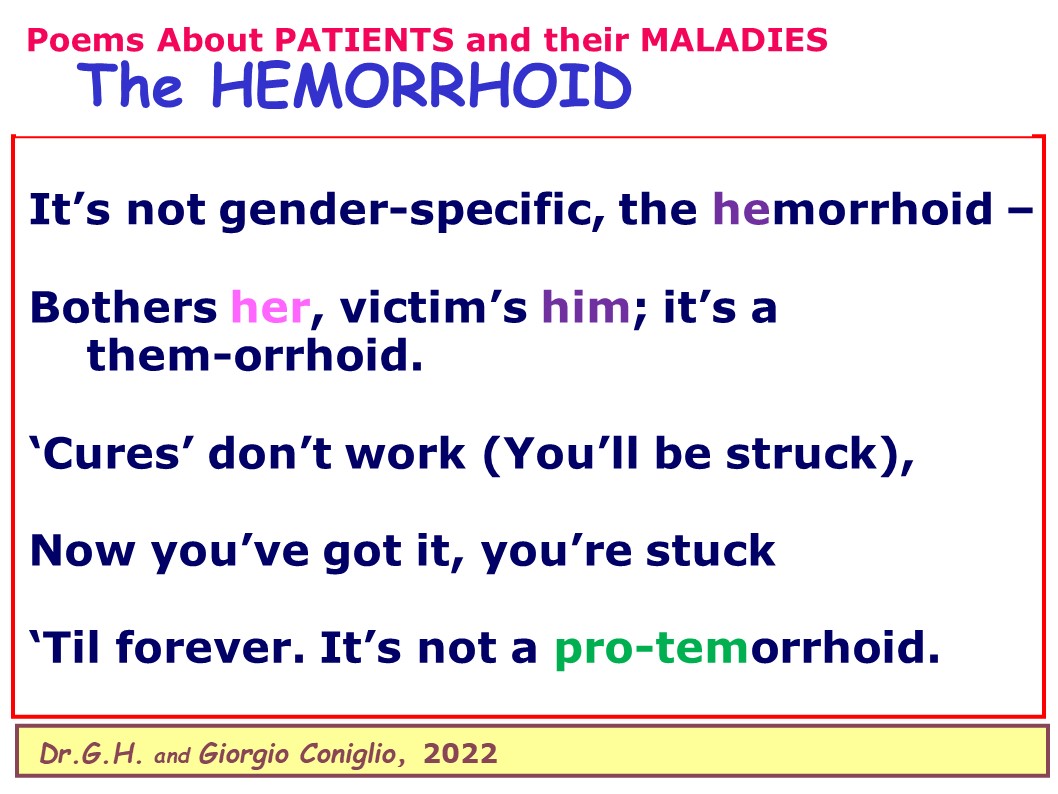
Graves disease, gynophobia, hemorrhoids, hemiplegia, hives, hoarding disorder.

CURRENT CONTENTS (#4):
Knee effusion
Lichen sclerosus
Male infertility
Nervous bladder
-OMAs
(non-tumorous)
Pica


Authors' Note: This verse resulted from the author’s personal experience (as patient).
  Following trauma, standard X-rays taken in the Emergency Department show most fractures where the bone fragments are displaced. They can not, however, diagnose many undisplaced fractures, particularly in elderly patients with reduced bone density. 
  Nonspecific swelling with evidence of leaking of fluid into the adjacent joint space (joint effusion) is particularly common in injuries about the knee, and is easily discerned on visual inspection and X-rays. Follow up radiographs after another 3 weeks sometimes display an initially missed healing fracture. In cases where instability, ongoing pain, or persistent effusion are prominent, injury to ligaments may be suspected. 


                                .
Authors' Note
dermatosis: general term for a skin condition
Lichen sclerosus, a chronic skin malady of unknown cause, with lesions affecting primarily the genital areas, is most often a scourge of women, but men sometimes become sufferers. Caring for sensitive skin areas by avoiding scratching and restrictive clothing is a necessary lifestyle change. Lifelong use of potent steroid creams has been shown to reduce the chances of malignant transformation.


Authors' Note:  In medical parlance, ejaculate is pronounced differently as noun (n.) or verb (v.) As a patient in the process of fertility testing, you will undoubtedly be asked to contribute (v.) a sample (n.), to assess sperm quality and cell count.


Authors' Note: Final requests have also been discussed at OEDILF by poet-editor speedysnail.


Authors' Note  Well, yes.
  With advancing age, life becomes a minefield of unexpected diseases; for several of these, the suffix -oma, implying growth or swelling, is used although an underlying neoplastic process is not present.

  In the elderly, subdural hematomas or intracranial bleeds (within the envelope of membranes surrounding the brain) may occur with minimal trauma or even spontaneously, particularly if anticoagulants have been used. 
  The patchy process of atherosclerosis may involves the left main coronary artery or its major division, the left anterior descending artery. In such cases, sudden clotting with blockage of the artery may occur at the site of atheroma, and cause a severe heart attack with cardiac arrest, a major cause of sudden death in the middle-aged and elderly population.
  This verse is a companion piece to others by the author dealing with malignant tumors and benign tumors; these are found in the collection of 'Oncologic Verses'.


poetry lyrics:/ Prudence, pregnant got into the mood/ Where she craved
 some bizarre forms of food./ Crudely nibbling on plywood/ She proclaimed,
"this is dry wood;/ It's much better (so good!) when unglued." 


GENERAL DIRECTIONS FOR WEB-EXPLORERS: 
To resume your review of the sequence of daily titillations on our related blog "Daily Illustrated Nonsense", click HERE. Once you arrive, you can select your time frame of interest from the calendar-based listings at the bottom of the page, and check the daily offerings for any month from the start of 2020 through the summer of 2026. 
As of March, 2026, there are 2,000 unique entries available on the daily blog, displaying individual poems (often illustrated) and wordplay, but also with some photo-collages and parody song-lyrics. 
Most of these key elements of our work are assembled here on "Edifying Nonsense" in topic-based collections.
The "Daily" format, a formidable mix of genres has the advantage of including song-lyrics, videos and other material that are not shown here on this topic-based blog.


Saturday, 10 August 2024

AUG 10 '24: CANADIANA #5

This offering represents the continuation of a collection of blogposts that we shared starting in August 2020, dealing with Canadian history, places, concepts and habits. 

previous posted poems (part#1) 
Canadian spelling
speech borrowings
Canadian moose
Canadian weather
Torontonian / Buffalonian
compassionate use
overwintering waterfowl
seniors' hockey

CURRENT CONTENTS(part #2)
Kim Jong Un's visit
Snow-biota
Thanksgiving, Canadian
Haida Gwaii
Joual
Prairie home
Mounties
Canadian raising (linguistics)


prospective verse
Nanaimo bars
Founding cultures (Canadian origins)
Crept and leapt
Dontinental unification -- 'fifty-first'
Newfoundland potato famine (3 verses, a 'brief saga')


Authors' Note:  There is no satisfactory explanation for the similarity of the words encumber and cucumber.

   Kim Jong Un, third successive member of his family's ruling dynasty, became leader of North Korea in 2011. He has since garnered world attention by his blustering role in his country's programs to develop missiles and nuclear weapons; the latter are widely known informally as nukes.

   In the northern Canadian territories (Northwest Territory, Nunavut and the Yukon), the soil is poor in organic components and prone to salinity and permafrost. Cucumbers, known informally as cukes, must be imported into the Yukon from crops grown further south. The reader may well agree that these territories should remain nuke-free as well as cuke-free.


Authors' Note:

coyote: wolf-like wild dog,  with range recently extended into southern parts of Canada, and into Carolina coastal communities; a member of the canid family, as are dogs and wolves

cuanto: Spanish for 'how much?’

Pierre (PEER): town named by French explorers, capital of the U.S. state of  South Dakota, located due west of Toronto (2,100 km or 1,330 miles by highway).
  
  In the United States, nicknames (official or unofficial) for individual states are important for aspects such as vehicle licensing plaques, sports team designation and political bloviation. Geographic features and indigenous plants and animals may be so used, as in South Dakota, 'the coyote state’, and South Carolina, 'the palmetto state’.


Authors' Note: 

Acadia (uh-KAY-dee-yuh, as here, or uh-KAY-dyuh) or  l'Acadie: (French), name given in colonial times to the region corresponding to today's Atlantic Canada (the Maritime provinces)

tofurkey: a vegetarian substitute for turkey made from tofu

Action de grâce (ak-syon-duh-GRAS): literally action of grace; name derived from continental France for a harvest festival

habitants: French colonial settlers, a term honored in the title of Montreal's professional hockey team

   Thanksgiving Day, or Action de grâce, is a statutory holiday in the majority of Canadian provinces and territories, observed on the second Monday of October.


web-photo


Authors' Note:

snowbird: a Canadian retiree seeking a warmer venue to spend the wintry months

  The Queen Charlotte Islands are a Canadian archipelago situated between 
the northwestern tip of Vancouver Island and the Alaska Panhandle, with landmass one-third that of the Hawaiian Islands (the latter located considerably further south). They had been the heartland of the aboriginal Haida people, who numbered thirty thousand at the time of first contact with European explorers in the eighteenth century. Their territory has a unique environment based on moderate temperatures and heavy rainfall. The province of British Columbia renamed the islands Haida Gwaii (HIE-duh GWIE[-ee], 'islands of the people') in 2010.


Authors' Note: Accent is a word written similarly, but spoken very differently in French and English. Joual (ZHWAHL) is the name for the accent, grammar and even spelling used naturally by many speakers in the Canadian province of Quebec; this dialect had evolved over several centuries separately from the language spoken in France. In schools, businesses and media in Quebec and other francophone areas of Canada, 'québécois' (kay-bay-KWA), more standard French, with a local inflection and local vocabulary, now predominates. In Canadian English and French, residents of the province are known as Quebeckers or Québécois respectively.


Authors' Note: In its evolution from poem to unofficial anthem, the iconic American song "Home on the Range" was known for a time as "Western Home". The lyrics evoke the wilderness surrounding settlements on the "High Plains" in the old west, but do not mention the construction techniques for homebuilding. With little timber available to build cabins in some areas, thick prairie grass could be used as a covering for dwellings, even allowing the cutting of standard door and window openings.

   In Canada, the geographically similar area bordering the American plains has been known almost exclusively as the Prairies. The author imagines that living in a sod hut on either side of the border would be a more inviting prospect for settlers once the herds of buffalo had been thinned out by overhunting (an environmental desecration that occurred in the latter part of the nineteenth century).

    Readers are reminded that they can, if so desired, sing the poem's lyrics to the tune of  "Home on the Range", and on our daily blog you can find suggestions for doing so HERE

For further reading; 1)https://www.thecanadianencyclopedia.ca/en/article/sod-houses

                                 2)https://en.wikipedia.org/wiki/Home_on_the_Range


 Alberta, 1908
web-photo: Glenbow Archives


Authors' Note: Spokesperson "Miki" is a Canadian woman of Japanese extraction who is a "Mountie", common moniker for a member of the Royal Canadian Mounted Police, a name deriving from the service's early days. Horses now play only a minor role in the RCMP's primary goal, the enforcement of federal criminal law; they are still used for crowd-control maneuvers, and in public spectacles, including the well-reputed "Musical Ride". Since 1966, however, horseback riding is no longer a mandatory skill required in the training of new officers. 
  Under contract, the RCMP also provides policing service to eight of Canada's ten provinces (Ontario and Quebec being the exceptions), the three Canadian northern territories, and 600 indigenous communities. Under its purview are towns such as Whitehorse, Yukon, and Hay River, Northwest Territories. 


Authors' Note: This is a mostly true story.
The Canadian internist in question had moved south to undertake a fellowship at an American medical school. As an introduction to potential staff mentors, he was asked to prepare a lecture on aspects of gout.
The transcriptionist, a southern woman, was victimized by her unfamiliarity with "Canadian raising", a speech variation altering and shortening the sounds of vowels in words like houserice and out; this pattern affects the speech of many speakers in the northern US, as well as in Canada.  


To view more verses dealing with Canadiana, check out this later post (part #3) by clicking HERE.


GENERAL DIRECTIONS FOR WEB-EXPLORERS: 
To resume your review of the sequence of daily titillations on our related blog "Daily Illustrated Nonsense", click HERE. Once you arrive, you can select your time frame of interest from the calendar-based listings at the bottom of the page, and check the daily offerings for any month from the start of 2020 through the summer of 2026. 
As of March, 2026, there are 2,000 unique entries available on the daily blog, displaying individual poems (often illustrated) and wordplay, but also with some photo-collages and parody song-lyrics. 
Most of these key elements of our work are assembled here on "Edifying Nonsense" in topic-based collections.
The "Daily" format, a formidable mix of genres has the advantage of including song-lyrics, videos and other material that are not shown here on this topic-based blog.

Monday, 5 August 2024

AUG 5 '24, BINOMIAL EXPRESSIONS: third set of examples


    This post is a continuation of a collection of verses dealing with the grammatic device of 'BINOMIALS' as posted on this blog on August 5, 2022 (first set of examples), and August 5, 2023 (second set). 

Editors' Note:  Before proceeding to these collections of short verses, readers might benefit from reviewing an earlier post entitled Edification about Word-Pairs: "The Binomials", A Linguistic Lesson.

previous poetic posts (Note that captions are available for poems displayed on "Daily Illustrated Nonsense" after January, 2024).

(first set): betwixt and between, bigger and bigger, birds and bees, bump and grind, by hook or by crook, down and out.  

(second set): far and wide (hives), first and last, flora and fauna, flotsam and jetsam, food and drink, hale and hearty.


CURRENT CONTENTS (#3, AUG 2024):
Hem and haw
Here and there
High and dry
Hug and kiss
Poop and scoop
Publish or perish


Authors' Note: In deciding on their wedding vows, brides and grooms often pick binomial expressions owing to their aura of tradition and their musicality. Such phrases, bordering on clichés, include:
for better or for worse, to have and to hold, richer or poorer, and in sickness and in health. The ultimate cliché in this formulaic construct (that protagonist Cliff felt pressured to recite) is usually "til death do us part" (not a binomial).

Generally,  following recitation of the vows, the co-opted man and wife get photographed, and then the whole wedding-party goes off to celebrate. In the case described above, the mandatory recitation was distorted, leaving the guests high and dry


Authors' Note: The rhyming binomial phrase, stoop and scoop, sometimes given as '"poop and scoop" describes a group activity by pet-owners.
See also the author's poem "dog park" in the collection "Urban Concerns". 


Authors' Note: The above treatise was assisted by a grant from the Foundation for Classic Binomial Expressions, under which permission was obtained for the use of song and dance, ants in one's pants, and publish or perish. (Other paired expressions, cheer and cherish, and funding and grants, are under development).


CURRENT CONTENTS (#4, 5 AUG 2026):
Right or wrong (billing and cooing - pigeons
Sin and redemption


GENERAL DIRECTIONS FOR WEB-EXPLORERS: 
To resume your review of the sequence of daily titillations on our related blog "Daily Illustrated Nonsense", click HERE. Once you arrive, you can select your time frame of interest from the calendar-based listings at the bottom of the page, and check the daily offerings for any month from the start of 2020 into calendar year 2026. 
As of March, 2026, there are 2,000 unique entries available on the daily blog, displaying individual poems (often illustrated) and wordplay, but also with some photo-collages and parody song-lyrics. (Readers are advised, however, that advancing age and other factors have resulted in the gradual decline of 'daily' blog offerings to ten times per month). 
Most of these key elements of our work are assembled here on "Edifying Nonsense" in topic-based collections.
The "Daily" format, a formidable mix of genres has the advantage of including song-lyrics, videos and other material that are not shown here on this topic-based blog.